The President comments: ‘Strengthening NZNO’s bicultural relationships’

First published in Kai Tiaki Nursing New Zealand, February 2016. Reproduced with permission.

12642467_10208230636149412_9220235493931106726_nASK ANY nurse to name the Nursing Council competency they find hardest to demonstrate in their self-appraisals and, chances are, they’ll pick competency 1.2 (applying the Treaty of Waitangi to practice).

This month, we commemorated the 176th anniversary of the signing of our nation’s founding document. So why is it still so hard for many of us to document how we apply the principles of the Treaty of Waitangi/Te Tiriti o Waitangi to nursing practice? What can be done to change that? And why does it matter, anyway?

One reason it matters to all healthcare workers is the ongoing disparity in health status between Māori and non-Māori.

This disparity can be partly explained by factors outside the clinical setting, such as the socio-economic determinants of health. But the data shows the disparity is also partly down to us and the care we deliver in the health system.

Equally, though, extending our understanding and application of Te Tiriti provides a rich pathway to development. When Māori speak about working in a mainstream organisation, they sometimes talk of “walking in two worlds”. For them, that’s a necessity.

Pākehā and other tauiwi have the privilege of choosing to expand the horizons of their world, by embracing other ways of seeing and other models of health, like Te Whare Tapa Whā.

There’s an Aboriginal saying about working biculturally: “If you have come to help me, you are wasting your time. But if you have come because your liberation is bound up with mine, then let us work together”.

Te Tiriti also matters to NZNO. As our newly-adopted NZNO Strategic Plan 2015-2020 puts it, we must “integrate bicultural practices and apply a bicultural lens to the way we work”, to fulfil our constitutional mission.

Bicultural journey

NZNO has been on a journey towards biculturalism ever since it was formed in 1993. We are enormously fortunate to have established a relationship between NZNO and Te Rūnanga o Aotearoa, along with a co-leadership model, with the president and kaiwhakahaere working alongside each other.

But, as we were reminded at last year’s AGM and conference by guest speaker Heather Came, we’re still not completely there yet. At the close of the conference, Chief Nurse Jane O’Malley summed up Came’s message: “Her challenge to this organisation is, what is your plan for institutional racism?”

Some of the conference delegates have already gone back to their committees and started working on plans.

I want to support all NZNO groups to work on this issue. Our bicultural relationships are just like the other relationships in our lives. Even when they’re going well, we need to keep nurturing them, if we want them to remain fulfilling.

When NZNO achieves its bicultural goals, then, as the Strategic Plan 2015-2020 says, it will also “strengthen NZNO members’ ability to recognise and demonstrate an understanding of tikanga Māori”.

We would like to reach the point where all nurses feel confident in demonstrating how they apply Te Tiriti in their practice. When we get to this point, we will have achieved the highest health status for all. •

My ‘Report Card’: Nursing & Health in 2015

Nursing Review E-Edition 2015 cover
This article was first published in Nursing Review. Reposted with permission.

Nursing and health in 2015 made great strides forward in:

Great strides have been made this year in removing regulatory barriers that prevent nurses from making the best use of their knowledge and skills.

The movement of the Health Practitioners (Removal of Statutory References to Medical Practitioners) Bill through Parliament raises hopes that we’ll soon achieve this, enabling a more efficient and effective health system.

NZNO supports this Bill. We also hope our suggested improvements are taken on board by the Select Committee when it reports back to Parliament in February.

Passed but could do better next year:

The progress made in implementing Care Capacity Demand Management (CCDM) across the district health board (DHB) sector deserves a pass mark.

This year, Bay of Plenty achieved the distinction of being the first DHB “over the line”, meaning the core components of CCDM have been implemented for all their acute medical/surgical areas.

Hawke’s Bay and Taranaki DHBs joined the CCDM programme, and Auckland DHB began the enormous task of rolling it out across its many inpatient areas.

But from NZNO’s perspective, there are still five DHBs not currently active in the programme, with two more “pending”. Progress elsewhere remains painfully slow. There are even backwards steps at some DHBs.

Given the critical importance of safe staffing, both for NZNO members and for quality of care in our public hospitals, more definitely needs to be done in 2016.

Areas showing initial promise but failing to deliver in 2015:

For new graduate nurses, the year began with movement towards NZNO’s goal of 100 per cent graduate employment by 2018 at the latest. NZNO’s 2014 petition campaign, alongside a report from the National Nursing Organisations, had secured funding to cover Health Workforce New Zealand’s contribution towards another 200 NETP (nursing entry to practice) places.

Raising the cap from 1100 to 1300 places this year still wouldn’t provide full employment. And the actual number of places was always dependent on the ability of employers to offer jobs.

Sadly, cash-strapped DHBs and insufficient participation from other sectors has meant the promise of 1300 NETP places was not fulfilled.

In September, therefore, delegates to the NZNO AGM voted for a motion: “That NZNO continues to prioritise and support campaigns towards nurses and midwives entry to practice programmes, for registered nurses, registered midwives and enrolled nurses, with the campaign goal of 100 per cent employment of new graduates and improved health workforce planning in Aotearoa”.

Areas that failed abjectly:

Budget 2015 failed abjectly, once again, to provide sufficient funding for health.

According to Council of Trade Unions economist Bill Rosenberg, Vote Health was $245 million behind what is needed to cover announced new services, increasing costs, population growth and the effects of an ageing population.

The accumulated funding shortfall in government health expenditure for 2015/16 compared with 2009/10 is more than $1 billion.

This is what underlies the painfully slow adoption of CCDM, the failure of new grad employment opportunities to live up to their promise, and the growth of serious, related problems like care rationing.

This has to change next year.

The President comments: ‘Just a union?’

Kai Tiaki November 2015
This column first appeared in Kai Tiaki Nursing NZ, November 2015. Reposted with permission.

“It’s just a union” is a comment you hear about NZNO from time to time. It comes from decision-makers looking for a reason to ignore us, or from those few diehard colleagues who say they’ll never join. Sometimes you hear it from members, too.

This issue of Kai Tiaki Nursing New Zealand reports on the Council of Trade Unions Biennial Conference (p11), which I attended as part of a strong NZNO team. So it’s a fitting time to remember that yes, we are a union. But it might also be a good time to reflect on this “just a union” talk, and what to make of it.

I wonder if derives from a view that professional and industrial issues somehow belong to separate, even opposing dimensions. Perhaps there’s a related belief that greater attention paid to one dimension means less attention for the other.

After all, NZNO staff are organised into separate professional and industrial teams. One team focuses on strategies to strengthen confidence in nurses in support of greater status and authority, in line with other powerful professions. It works closely with members belonging to NZNO’s colleges and sections.

The other team focuses on strategies to promote fairness at work, for all. It draws on the power afforded by employment rights and the caring work we collectively perform. This team provides close support for workplace delegates.

The idea that they’re somehow in competition leads to arguments about the right “balance” – or worse, advocacy for one strategy, over the other.

In this context, talk of NZNO as “just a union” can arise and create division, where none should exist. This is because professional and industrial realities are not opposing dimensions, but inseparable parts of a whole.

This is clearly embodied by those members who are both leaders in their college or section, and delegates in their workplace.

So strategies should not be based on one part of our reality, or the other, but on the shared goal we’re trying to achieve.

I believe that in the broadest sense, the goal we are pursuing as NZNO members is the wellbeing of people. And we are people too, just like our patients, whānau and communities.

Viewed from this perspective, our industrial and professional (and political) strategies become mutually reinforcing approaches. When members are presented with this perspective, I think it feels right, at a gut level.

It can be hard to uphold these truths sometimes, I know. Our allies and external stakeholders tend to pull us in one direction or the other.

Some of our union allies, for example, are suspicious of “professionals”. And some health sector leaders don’t trust unions.

But we shouldn’t let external forces define us. We should stand on our own whole reality, and reject attempts to divide it.

We are not “just this”, or “just that”. By proudly embracing our dual identity as a professional association and registered union, NZNO members can achieve our common goal together.

Nursing Review: Q&A with Grant Brookes

Nursing Review October 2015
This interview first appeared in Nursing Review, October 2015. Reposted with permission.

Q. Where and when did you train?

A. I was one of the young BN pioneers, going forth blinking into the bright new day for nursing education. In 1992, I joined the first intake of the undergraduate degree programme at Otago Polytech. After a gap year and some part-time study, I graduated from there in 1996.

Q. Other qualifications/professional roles?

A. Prior to my current position, my most recent professional role was on the National Committee of the NZNO Mental Health Nurses Section, where I served as co-editor of our Head2Head journal.

Q. When and/or why did you decide to become a nurse?

A. Working in hospitality after leaving school, I found I enjoyed serving people. I also relished an intellectual challenge, completing a physics degree and a diploma in liberal arts at Otago University. The Bachelor of Nursing programme seemed to bring these two things together. But after graduating with my BSc(Hons), I sought above all a meaningful job I could put my heart and soul into. Friends and family more conditioned by gender stereotypes asked why I didn’t do medicine. But while volunteering at the Otago Community Hospice in 1991, I found the rewarding career I was looking for – nursing.

Q. What was your nursing career up to your latest position?

A. Providing direct care for mental health service users has been my passion. So I’ve spent my career at the coalface, in the community and in inpatient units in Auckland, London, Wellington and Melbourne.

Q. In recent years you have stood for Capital & Coast DHB, Hutt City Council and now have been elected NZNO president?  What has drawn you to seek public office?

A. Working in mental health, as I have done, you see social exclusion up close. The reality of the social determinants of health is unavoidable. And as an NZNO leader, I have seen how the voices of nurses can be marginalised and ignored. In 1987, the World Health Organisation published Leadership for Health for All: The Challenge to Nursing. The strategy document said: “Because politics is the vehicle of policy making and social change, some nurse leaders will have to combine the gentle art of nursing with the rougher one of political activity”. I have stood for public office to respond to that challenge. I have strived to provide a voice for those who are under-represented, to focus public debate on the social determinants of health and to help people take action themselves for change. 

Q. What are you looking forward to most about your new nursing leadership role?

A. I am looking forward to continuing to connect with NZNO members. I’m committed to bringing their voices, their issues and successes to the board table, so that our organisation is guided the membership. I am also excited about strengthening the bicultural relationship within our organisation, in order to support stronger action for Māori health. 

Q. What are you looking forward to least?

A. See below, for what I’m reading instead of the interesting books gathering dust at my bedside.

Q. If there was a fairy godmother of nursing what three wishes would you ask to be granted for the New Zealand nursing workforce?

A. I would ask for safe staffing, so that nurses can deliver the care we dearly want to provide, and not go home utterly exhausted or in tears. I’d ask for pay equity – an end to the discrimination based on gender, ethnicity or sector – and for a supported entry to practice place for every new nurse.

Q. What do you think are the characteristics of a good leader?  And are they intrinsic or can they be learnt?

A. My favourite quote about leadership comes from Dr Cornel West, a Professor of Philosophy whose career has spanned Harvard and Princeton: “If your success is defined as being well-adjusted to injustice and well-adapted to indifference, then we don’t want successful leaders. We want great leaders – who love the people enough and who respect the people enough to be unbought, unbound, unafraid and unintimidated to tell the truth”. These are characteristics which can acquired, through practice, by some.

Q. What do you do to try and keep fit, healthy, happy and balanced?

A. I have recently become a runner. This year I entered the 10km race at the Wellington Marathon, as part of the Capital & Coast DHB Team. I was chuffed to finish 77th out of 1,105. Our team came third overall and raised $4,000 for the Heart Foundation.

Q. Which book is gathering dust on your bedside table waiting for you to get round to reading it?

A. There are two books gathering dust there – Maire Leadbeater’s Peace, Power & Politics: How New Zealand Became Nuclear-Free, and The Chimes by Wellington author Anna Smaill. I confess that when it comes to novels, I’m one of those time-poor individuals who lets the Man Booker judges do the searching. The best book I’ve read this year, however, is Naomi Klein’s This Changes Everything: Capitalism vs the Climate, which is now a feature documentary. It was timely, as delegates at our AGM last month voted that NZNO should support fossil fuel divestment. 

Q. What have you been reading instead?

A. In week two of my new role, sadly my reading seems to be governance manuals, terms of reference, financial statements and previous minutes.

Q. While waiting in the supermarket check-out queue which magazine are you most likely to pick up to browse and why?

A. I sometimes despair at the New Zealand media landscape. The only magazine I’m likely to browse at the check-out – for intelligent commentary, fashion and more – is Rolling Stone

Q. What are three of your favourite movies of all time?

A. Selecting three all-time favourites would be too hard. But my top three from the last year are Selma, Testament of Youth and The Dark Horse. Thanks for asking!

Taking the temperature of NZNO

Kai Tiaki Oct 15 cover
This article first published in Kai Tiaki, October 2015. Reposted with permission.

This issue of Kai Tiaki Nursing New Zealand reports on NZNO’s annual general meeting (AGM) and conference, held in Wellington last month. (See pp12-19.) As a three-day affair, starting with the college and section day and National Student Unit (NSU) AGM, and proceeding through the business of the AGM and then onto the conference, the annual gathering provided an unparalleled opportunity to check the vital signs of our organisation, in the current environment.

The 176 NZNO members who took part will be surveyed and, in good time, their feedback will be analysed, collated and presented. But for now, I’d like to document my own initial assessment and plan, to supplement the priorities I outlined in my speech to AGM as incoming president (p18). I believe a healthy NZNO flows on to greater wellness for the people we care for every day.

Baseline readings for many of our systems are good. As chief executive Memo Musa reported, NZNO membership continues to grow, even if there are areas which need attention (p12). Our finances are healthy, and some environmental factors – such as rising support for pay equity in the wake of Kristine Bartlett’s court wins – support healthy development for NZNO and our wider community.

The high level of agreement on our collective vision and mission, reflected in the unanimous vote by those at the AGM to adopt the 2015-2020 strategic plan, shows an organisation in good heart.

And among the colleges and section reps who gathered on day one, the news is that, while a few committees are struggling a little to engage their members fully, many are powering ahead and producing work which is influential nationally and internationally.

But some other signs and symptoms on display at conference, and some other environmental factors discussed there, are less reassuring.

The main business of AGM each year is to debate and vote on remits, either to amend our constitution, or to set policy priorities for the next 12 months. It is then up to the elected board of directors to govern NZNO in accordance with the latest version of the constitution and any agreed policy priorities.

For many delegates at this year’s AGM, the remit debates might have confirmed Winston Churchill’s famous observation “that democracy is the worst form of government except all those other forms that have been tried”. 

Despite the frustrations of meandering debate, poor time-keeping and confusion over meeting procedure, the remits did allow the democratic voice of members to be heard at our top decision-making forum. And a theme could be heard in this membership voice. Among the 12 remits, five indicated members want more say in running NZNO, more checks and balances for the board, or both. During the debates, one delegate said it appeared some members feared our board and leaders.

Meanwhile, the board put forward a remit of its own, to amend the constitution and grant itself the power to establish the overall strategic direction and policy of NZNO. This proposal was rejected, so the power will remain with the members who participate in the AGM. But it seemed strangely at odds with the theme of the other remits. Strengthening the relationship between NZNO’s elected leadership and members will be a top priority for me over the next three years, in my role as co-leader. Listening to members at every opportunity will be essential to achieving this.

In our wider environment, too, there are some noxious influences. In his speech to conference, Health Minister Jonathan Cole- man reminded us that our sector received the largest share of new spending in this year’s Budget – $400 million, in all.

What he did not mention was that this was less than the amount needed to keep up with rising costs, or that increases in previous years have also failed to keep up. Council of Trade Unions economist Bill Rosenberg estimates the accumulated funding shortfall in government health expenditure for 2015/16, compared to 2009/10, is more than $1 billion.

Impact of funding shortfall 

Many NZNO members are feeling this funding shortfall. They are finding they must do more and more, with no corresponding increase in resources. And, in turn, it is placing greater strain on NZNO delegates and staff, as stressed members seek support.

This environmental factor has not yet caused serious harm to NZNO. But ensuring workplace delegates are well-supported and strengthening NZNO’s industrial presence will help to inoculate us from its toxic effects, while we campaign to change it.

And we will need to be fully fit as an organisation, to deal with the health effects of worsening social indicators and entrenched inequalities. For example, we must address the scandalous gap in life expectancy between Māori and non-Māori New Zealanders which, as Heather Came reminded us all at conference, is still 7.2 years for women and 7.4 years for men (p16).

After a brief time as president, then, this is my one-page initial assessment and plan for the organisation, as it presented in “the clinic” last month. As I stressed in my speech to AGM, NZNO leaders have a responsibility to lead, but in a democratic, member-run organisation like ours, the direction is ultimately set by the members.

So what do you think about the health of our organisation? Why not pen a letter to Kai Tiaki Nursing New Zealand about it now? Or, if you prefer, drop me an email at grantb@nzno.org.nz or message me via Facebook or LinkedIn.

I look forward to hearing your thoughts. •

Grant Brookes, RN, is NZNO’s newly-elected president.

DHB delegates speak: Why we’re backing Grant for President

Guest blog post by Erin Kennedy, lead RN delegate at Capital & Coast DHB

As voting continues for the NZNO Presidency, it’s heartening to hear that more members seem to be using their democratic right to choose our leader this time round.

At CCDHB, members and delegates have been lucky over the past few years to see Grant in action as a delegate and supporter of all our members.

Some of our delegates were keen to share their reasons for supporting Grant with members from other workplaces.

Simon Bayliss, a delegate in Theatres (right), said there was no doubt in his mind that Grant was the man for the job.

Simon Bayliss 2011“I like a guy who I can call an activist, who gets involved and cares about so many issues – big and small.”
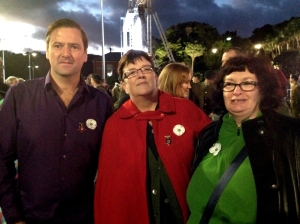
Women’s Health delegate Ann Simmons (right, at this year’s ANZAC Dawn Parade) said NZNO members deserved Grant as president in today’s difficult political environment.

Anzac nurses“He’s enthusiastic, energetic, intelligent, intuitive, has integrity, is one of us and can be trusted.”
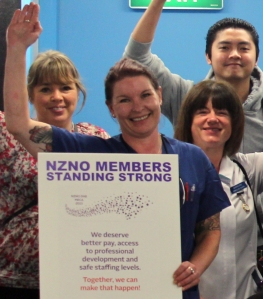
Kenepuru Surgical Unit delegate Emma Brooks said Grant was truly passionate about frontline RNs, HCAs, ENs and midwives. “He has not lost sight of the day to day struggles we face, or become lost in the corporate bureaucratic quagmire.

I support Grant Brookes because he is courageous enough to speak the truth. I support Grant because he is sincere and dignified. I support Grant because I believe in his message – Your Choice, Your Voice. I want an NZNO president who is visible, accessible and trustworthy – this is Grant Brookes.”

Delegate Kathryn Fernando from the Kāpiti Health Centre (front row, centre, at the presentation of the People’s Select Committee Report on the ERA in 2013), supports Grant because of his energy, passion, intelligence and commitment to social justice.

People's Select Committee report on ERA, 11.12.13 (crop)

“He is a very good communicator and would represent nurses, caregivers, ENs and midwives very well if he were to become president.”

PACU delegate Katrina Hopkinson (centre) said she found Grant approachable and a great mentor.

NZNO MECA meeting, Wellington, 15.10.14 (crop)”I’ve seen close up how much energy he puts into NZNO, both as a delegate here at CCDHB, and on the National Delegates’ Committee. He cares deeply about others and works for change.”
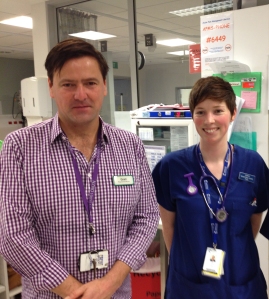
CCDHB 10.6.15 IMG_3393 (crop)Katrina’s fellow delegate in the Post Anaesthetic Care Unit, Jemma Irvine, states simply:
“He’s active and involved and knows the reality of nursing today.”

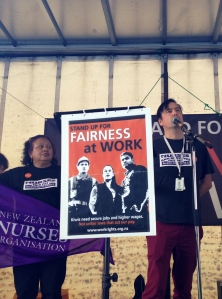
Ward 6 North delegate and Enrolled Nurse Anita Te Kahu (pictured at the CTU Fairness at Work rally in 2013) is another long time colleague who has seen Grant in action over the years. Asked why she supports Grant, her answer is simple. “Why the hell not? He’s the only one that is worth it!

Fairness At Work NZNO 20082013 (crop)

He is a people’s person, approachable, a listener and a thinker. Committed to a mission, he does not give up. As the new NZNO President, Grant will continue to be our mouthpiece and fight for what is right.

I believe he will continue to mix with the workers, those at the coal face every day.”

11232340_10152752314507035_731593285_oAnd finally, as CCDHB’s lead RN delegate, I have worked closely with Grant on many issues affecting our members, including safe staffing, underpaid shift leave, personal grievances and budget cuts.
His commitment to our members and to our union values is unmatched by any other candidate. If an issue needs sorting or a members needs support, Grant is there – frequently on his day off or after a tough night shift. Vote Grant Brookes for president.

_______________________________________

Members should have received an email with instructions on how to vote online on 19 June. (If you haven’t, check your spam folder). Or, if you’re one of 8,000 or so members without a current email address on file with NZNO, you should have received voting papers in your letterbox. If you haven’t received either, phone the Member Support Centre on 0800 28 38 48. Remember, democracy is only as strong as the number of us who have our say!

Aged care injustices wrong us all

Martin Luther King beautifully articulated a core union value when he said, “injustice anywhere is a threat to justice everywhere”.

I believe the injustices in aged care wrong us all,  both as health professionals and health consumers. And I think we must be more vocal in opposing the chronic undervaluing of both our elderly and those who care for them.

Everyone grows older. And everyone has family members who have grown older.

So why are older New Zealanders in care treated like second-class citizens? And why are those who do the caring work paid poverty wages?

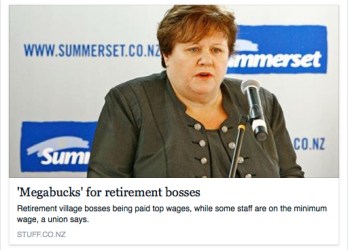
Megabucks for retirement bossesIn a sector where a quarter of workers are on the minimum wage, why do the managers get “megabucks”, as reported in the news last week?

Why does the managing director of Ryman Healthcare get $839,249 a year? Why is the chief executive of Metlifecare on $811,040?

In our hearts, we know why wages are low. The carers are predominantly women, who are traditionally undervalued in our society. And union density (the proportion of staff in a union) in the aged care sector has been too low to command the bargaining power needed to really change that.

And we know why the retirement bosses get megabucks.

Aged care has been largely privatised and corporatised in New Zealand, so that 77% of our aged care beds are now provided by private or corporate operators.

They are making huge profits. Ryman, for instance, has reported twelve consecutive years of record profit, and increased its wealth from $135 million to over $4.0 billion in the last 15 years. The job of corporate CEOs is to deliver a return to investors, and when they do it on this scale, they are richly rewarded.

But why then does our government, which pleads poverty when it comes to nurses’ pay negotiations, give Ryman over $800 million worth of taxpayers’ money every year?

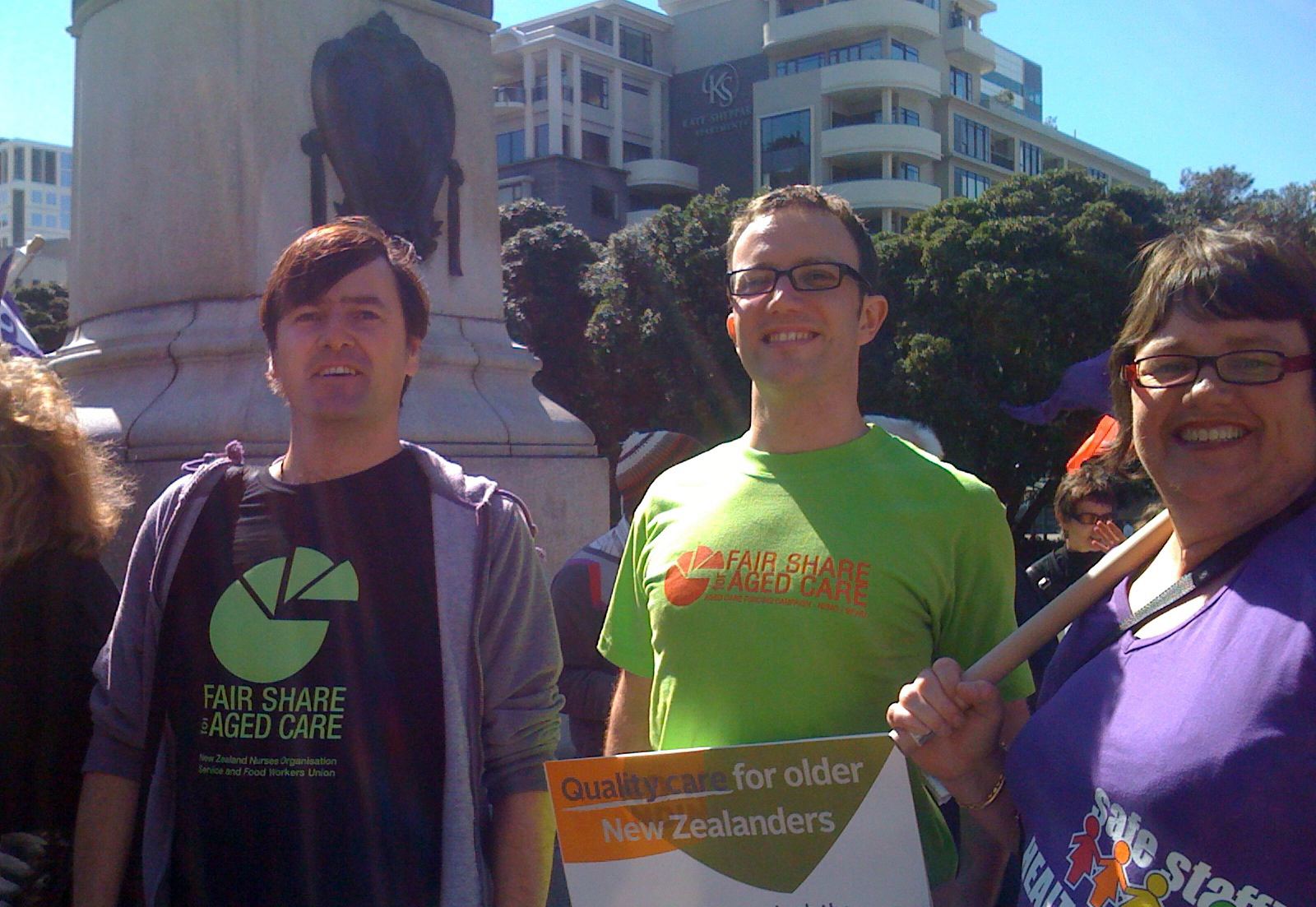
The Fair Share for Aged Care campaign was jointly launched by NZNO and the Service & Food Workers Union Ngā Ringa Tota in 2004. It aimed to increase union membership and collective bargaining in order to raise pay and the quality of care in the aged care sector, and spawned the Fair Share News.

Through determined effort – including industrial action – the campaign has won improvements (or limited the deterioration) for workers and residents in some aged care facilities.

Elderslea Rest Home Strike 1.3.12_MG_8169 (crop)
Supporting a Fair Share for Aged Care, rain or shine – on the picket line with striking Oceania workers, March 2012.

The Fair Share campaign has also taken the issues into the political arena. In 2011, Fair Share campaigners presented over 11,000 signatures in support of the Aged Care Charter to Parliament.

The Charter made four simple recommendations, each of which would have made a huge difference: Compulsory safe staffing levels and skill mix, fair pay and conditions, a nationally recognised training programme for all aged care staff and a guarantee that government funding is only used for care of residents.

Aged Care Charter presentation2 29.9.11 (crop)
At the Aged Care Charter presentation at Parliament, September 2011

Why did the government, which claims to represent all New Zealanders, reject all four recommendations?

And why did it also reject the recommendations of the Human Rights Commission the following year, when they released their Caring Counts report? Especially given the comment by EEO Commissioner Dr Judy McGregor that, “In my time as Equal Employment Opportunities Commissioner there has seldom been the degree of unanimity about a work-related issue than there is about the low pay of carers”?

But despite the government’s snub, the Caring Counts report did give rise to a tripartite Summit, which I attended last year and wrote about on the NZNO Blog, to keep up the pressure for change.

Caring Counts Summit 22.7.14
Conveying solidarity on behalf of NZNO’s DHB National Delegates Committee, at the Caring Counts Summit last year.

The hard truth is that in 2015 we still have a long, long way to go.

To reach our destination, I believe that NZNO leaders must raise the volume in their opposition to the injustices in aged care. I’d like to see NZNO leadership be as vocal as the Service & Food Workers Union were in the news story above, about retirement bosses’ pay.

Because ultimately, why we are mistreated matters less than how we respond.

In the 2013 local elections, when I stood as the NZNO-endorsed candidate for Capital & Coast District Health, my number one priority was, “Putting the care back into aged care“. As NZNO President, I will be just as vocal in demanding we deliver dignity for older people and a fair share for Aged Care staff.

No-one denies that Aged Care is neglected. It’s the poor relation in the health system. Yet we, with our 46,000 voices, have the power to challenge and ultimately change that injustice.

I pledge to use my voice loudly against this injustice. Will you join me?

The struggle for new graduate nurses

Last weekend, while visiting NZNO members in Christchurch, I met Sasha. CDHB 7.6.15 IMG_3366

Like hundreds of other final-year nursing students around the country at the moment, Sasha was celebrating the end of her three-year nursing degree, but facing the future with apprehension.

Firstly, there are State Finals coming up on 21 July. But a bigger uncertainty also looms.

New grads like Sasha are asking themselves, will I be one of the lucky ones who gets a NETP or NESP place? Will I get a job at all, to pay off all the debt I’ve accumulated?

It’s a real struggle for new graduate nurses today.

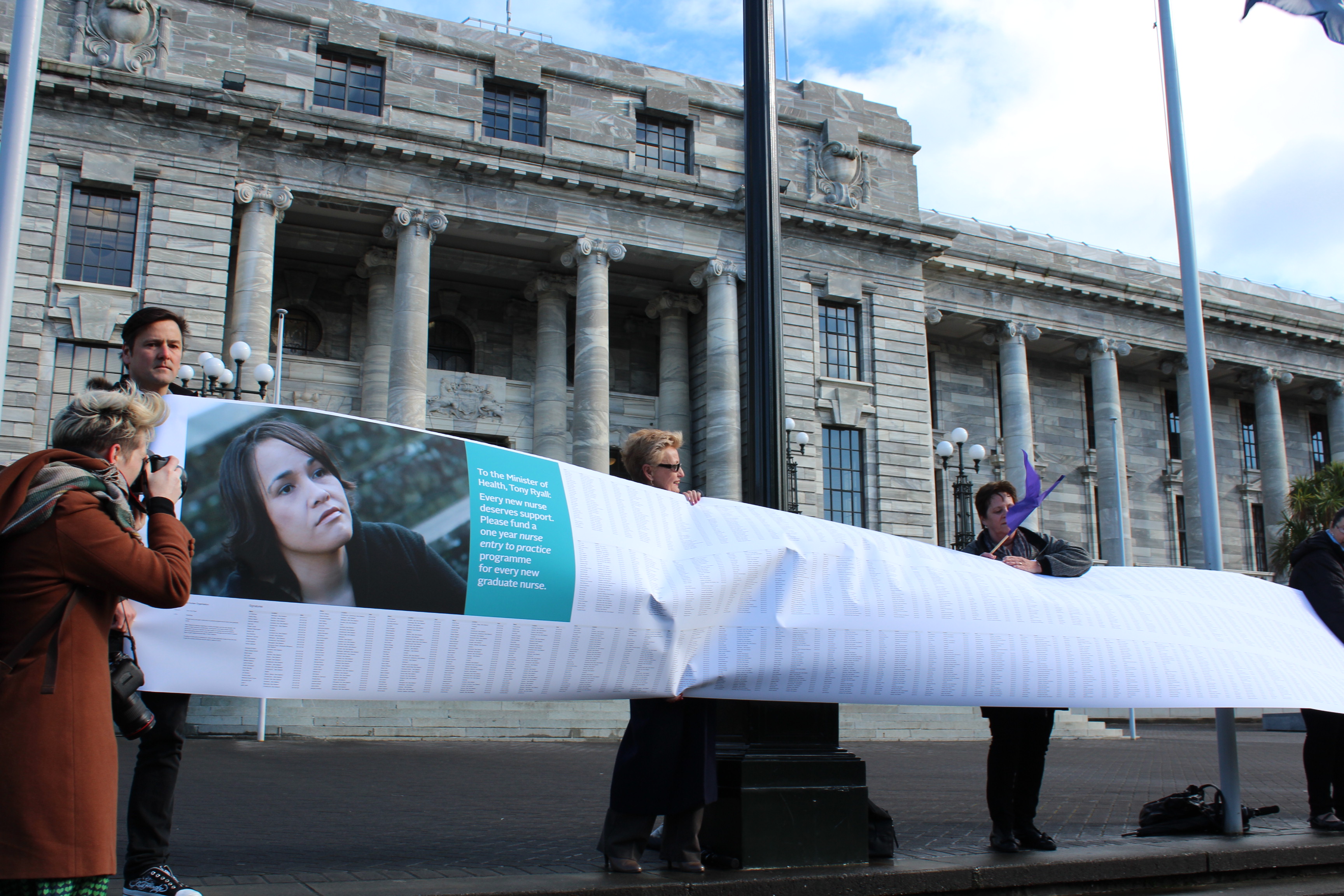
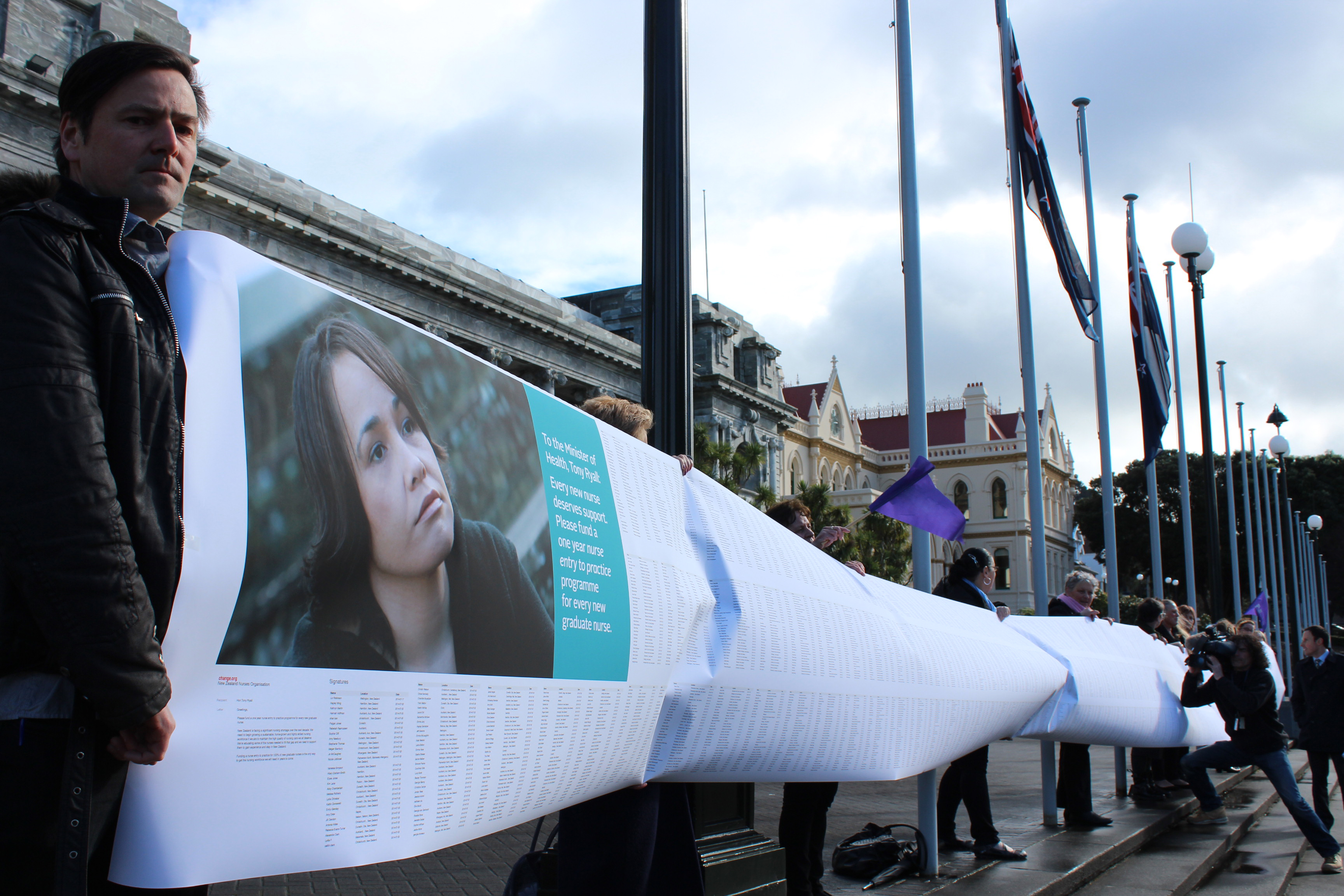
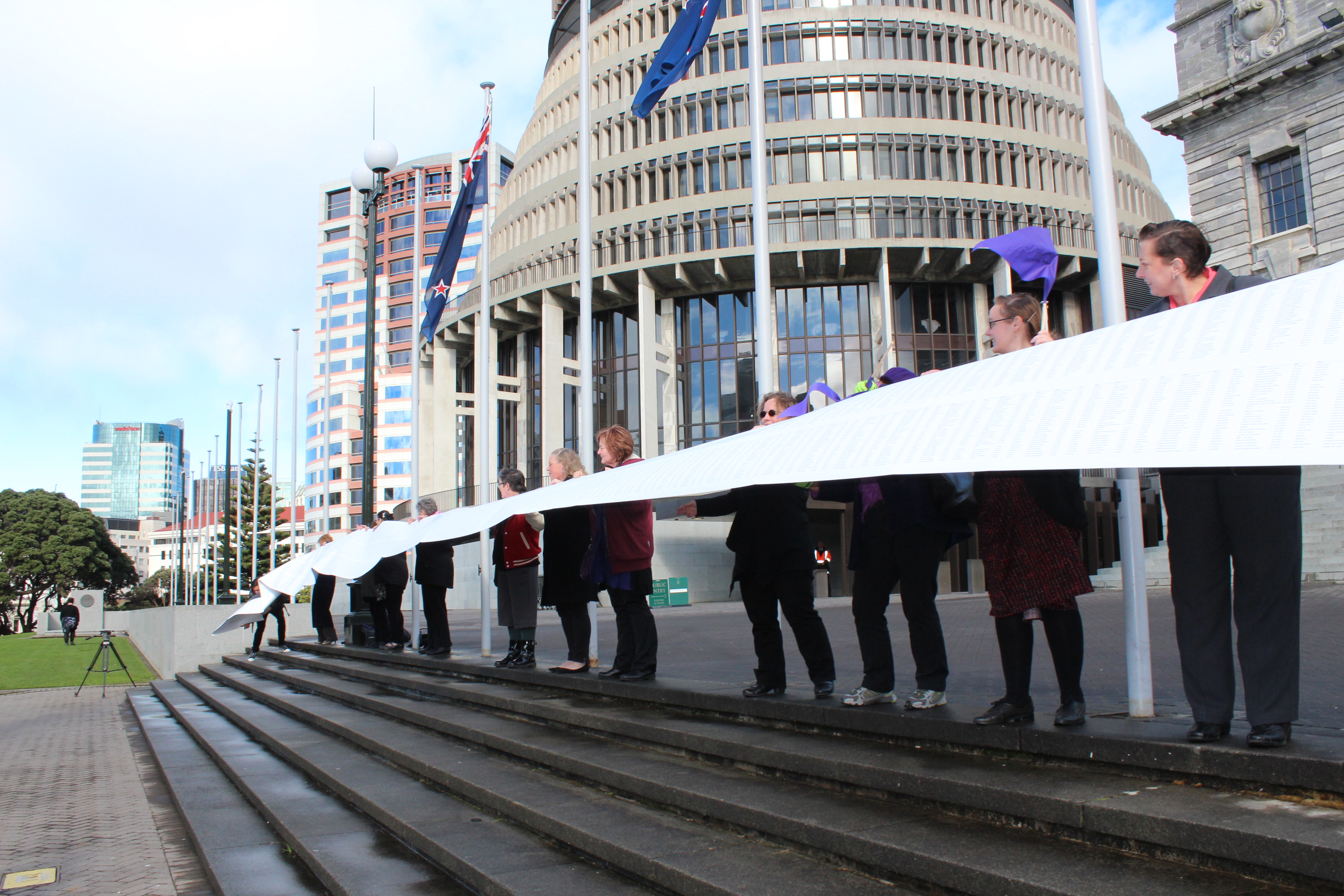
Last year, I was proud to be part of the NZNO campaign for a nurse entry to practice (NETP) position for every new grad nurse. The hugely popular campaign culminated in the presentation of an 8,000-strong petition at Parliament in August.

NZNO New Grad NETP petition 12.8.14 IMG_2963NZNO New Grad NETP petition 12.8.14 IMG_2987

NZNO New Grad NETP petition* 12.8.14 IMG_2990

NZNO New Grad NETP petition 12.8.14 IMG_2971

This collective action by NZNO members and supporters secured an extra $2.8 million from government to fund NETP positions for another 200 new grad nurses. It was a great win.

But there is still a long way to go. In March 2015, over 20 percent of last November’s graduates were still unemployed. And only 62 percent were in NETP or NESP (mental health) programmes.

Everyone admits that New Zealand is facing a big nursing shortage. The Nursing Council tells us it will impact by 2020. But as all the nurses working short-staffed know, in many areas it’s already here.

We need action to build up a sustainable, home-grown and highly skilled nursing workforce if we are to keep the high quality of nursing care we all deserve.

This is why I presented a remit on behalf of Greater Wellington Region to the NZNO AGM last September, “that NZNO prioritises new graduate nurse unemployment as a campaign issue in 2015”.

Delegates to the AGM voted to support this remit, but evidence of an NZNO campaign this year has been scarce.

Fortunately, in the upcoming NZNO elections all NZNO members have the opportunity to elect leaders who will drive this campaign forward.

As your NZNO President, I will lead the struggle for the future of our profession and keep on pushing for NETP places for all.

Celebrating International Nurses Day in Auckland

NZNO members in Auckland celebrated International Nurses Day on May 16 this year, with a stall at the Saturday morning markets in the suburb of Mangere. It was an honour to be invited to take part.

International Nurses Day is normally held on May 12, the anniversary of Florence Nightingale’s birth. But celebrating it on the following Saturday allowed members of the NZNO Greater Auckland Regional Council to continue a tradition of offering free health checks and health education to people in South Auckland.

This year, efforts were focused on smoking cessation advice and blood pressure checks.

lynnaire phone 754

lynnaire phone 753 (crop2)

Karen from Smokefree Nurses Aotearoa/New Zealand showed off new nicotine replacement therapies.

Some of these have just been introduced in New Zealand and are not yet widely available.

She also measured peak flow readings.

Once again this year, Florence Nightingale made a personal appearance. Auckland seems to get all the luck when it comes to sightings of this venerated founder of our profession.

lynnaire phone 744 (crop2)

She doesn’t look 195 years old, does she?