NZNO’s delegation meets up with International Council of Nurses’ chief executive Frances Hughes at last month’s Triad meeting. From left, CE Memo Musa, kaiwhakahaere Kerri Nuku and president Grant Brookes
Do you sometimes feel, when you’re battling to make positive changes in health care, that you’re banging your head against a brick wall? That it’s not even worth trying, because everything is decided higher up? Or that other priorities, like economics, will come first anyway? You’re not alone.
This is why NZNO representatives meet employers and government, to put the nursing agenda on the table. And it’s why NZNO kaiwhakahaere Kerri Nuku, chief executive (CE) Memo Musa and I went all the way to Geneva last month, to attend meetings organised by the International Council of Nurses (ICN) – the first under the new ICN CE, New Zealand nurse Frances Hughes, and new ICN policy consultant (and former RCN secondee to NZNO) Howard Catton.
As Catton told us in one meeting, “Nurses need to be at the table, not just for discussions on nursing policy, but health policy, social policy, housing, education. We need to be where all the social determinants of health are discussed.”
ICN enables this to happen at the highest level, by working with the labyrinth of specialised agencies that make up the United Nations (UN) system – and particularly with the World Health Organization (WHO), the International Labour Organization and the World Bank.
Feeding into WHA
The meetings we attended in Geneva were timed to feed into the World Health Assembly (WHA), a biennial gathering of the world’s health ministers and officials taking place under the auspices of the UN, the following week.
For the first two days in Geneva, we met more than 100 leaders of national nursing associations (NNAs) from around the world.
Then we all came together with regulators (including our Nursing Council) and government chief nurses in the Triad meeting, to formulate a nursing response to some of today’s key global issues.
The initial discussions revealed a remarkable level of agreement about the health issues facing the various NNAs, and about the necessary responses. The demands of ageing populations, non-communicable diseases and health workforce shortages have resulted in a worldwide shift towards nurse-led health care in the community.
To continue this shift, we discussed implementing the WHO’s Global Strategy onHuman Resources for Health: Workforce 2030. This strategy was adopted unanimously by the WHA meeting which followed, in a resolution that also affirmed“theemerging political consensus on the contributionof health workers to improved healthoutcomes [and] to economic growth” and the “mounting evidence that investments in healthworkforce . . . are conducive to economic andsocial development”.
The New Zealand government delegation to the WHA voted in favour, along with all the other countries, but also spoke about a need to ensure the best return on investments.
Meanwhile, the top-level shift away from thinking about health workers as a “cost” to the economy was also apparent during our ICN discussion of the UN Commission on Health Employment and Economic Growth and on the WHO Strategic Directions for Nursing& Midwifery 2016-2020, which was formally launched at the ICN NNA meeting.
Introducing that document, Catton commented that “there’s a healthy scepticismwhich says, strategies come and strategies go,and nothing changes”.
So NNA leaders were asked to come up with plans on how we could advocate for, influence and support implementation of these strategies back in our home countries, to ensure changes happen this time. A wide range of approaches was presented, including wielding our industrial power as unions and mobilising for political campaigns.
But there’s always a danger that powerful global institutions like the UN, WHO and the World Bank will drive the agendas of NNAs and ICN, rather than the other way around. The way to avoid this danger is the same at the global level as it is within NZNO: the members must be the ones who set the direction.
So the speech from ICN CE Frances Hughes on her transformation and regional engagement plan to ensure “the sanctity of the NNAs” was very reassuring. “Your role isparamount”, she said. “You are our members. You give strategic direction to the ICN board.”
After this, NZNO took the opportunity to convene an impromptu meeting of NNAs from the Asia-Pacific region, to ensure nurses from our region are heard more clearly within ICN in future.
We didn’t achieve all our NZNO goals in Geneva. In particular, more work will be needed to increase global understanding of indigenous nursing issues.
But we did manage to put pay equity for women onto the global agenda, getting the issue into discussion summaries at the NNA meeting and successfully proposing its inclusion in the official communiqué from the Triad meeting to the WHA. And we strengthened the message sent to the WHA about the need to invest more in nursing and midwifery workforces.
But if NZNO representatives are listened to in international forums like this, it is because of the efforts of NZNO members and staff. Your collective actions, in campaigns like “All the Way for Equal Pay” and the new “Speak Up for Health” campaign for better health funding, are what can elevate these issues all the way up to the international level.
So the next time you feel you’ve run up against a brick wall when you’re trying to make change, please take a deep breath and keep on pushing. •
(First published in Kai Tiaki Nursing New Zealand, June 2016. Reposted with permission).
Notes of my speech to the TPP – Let the People Decide – Binding Referendum Rally, coinciding with the release of the Select Committee report. (Photo: Sandra Grey)
If anyone’s been to hospital recently, for an operation, you’ll know the form they give you to sign. It’s the one asking your permission to do the operation.
It also tells you what the procedure is, and why the doctor is doing it – what benefits you can expect. It lists the risks, or possible complications which might arise. And it lets you know that you have the right to change your mind, because it’s your choice to decide what is being done to you.
The New Zealand health system hasn’t always had those forms. They didn’t have them in the sixties and seventies, at National Women’s Hospital in Auckland, when a doctor was conducting what became known as “an unfortunate experiment”. The doctor did not seek permission for his experimental cancer treatments. He did not even tell women that he was prescribing treatment considered unorthodox – or in some cases that he was prescribing no treatment at all, for women at risk of cancer.
It was the Cartwright Inquiry into this unfortunate experiment which enshrined a principle for healthcare in New Zealand – the principle of informed consent.
The doctor in charge at National Women’s was found guilty of disgraceful conduct, and struck off. But nurses were also criticised in the inquiry, for not speaking up.
So this is why we are speaking up now, about the TPPA. I’d like to thank Labour MP Grant Robertson for acknowledging the role of the medical – and nursing – professions, in leading the opposition to the TPPA. But actually, we feel we have no choice. We remember National Women’s. After the debacle there, defending the principle of informed consent is in our bones.
And there has been no attempt to gain the consent of New Zealanders, for this TPPA. Every public poll has found a majority of people opposed to it. In effect we are all being experimented on, without our consent.
We haven’t been informed, either. The deal has been done in secret. We have not been given any detail about the health risks that might come with the TPPA. The government’s 277-page National Interest Analysis glosses over health in just two pages – most of which is taken up denying there will be any effect on health at all.
But we know that access to affordable medicines will be reduced under the TPPA – especially for the revolutionary new drugs now in the pipeline, called biologics, which hold the promise of cures for cancers, and arthritis.
We know that the TPPA will limit our ability to tackle the health epidemics of the 21st century – such as alcohol-related harm, and non-communicable diseases like diabetes and heart disease, which are linked to obesity.
We know that the TPPA was negotiated in a way which breaches the Treaty of Waitangi, and will undermine Māori health efforts.
And we know that the TPPA will undermine the social determinants which sustain good health. It will lead to increased inequality, and this will impact on the health of New Zealanders.
We know all this, even though we aren’t patent lawyers, or trade experts, or economists. We’re nurses. And we know this without access to all the secret documents passed back and forth around the deal.
It’s because we know this much, that we’re absolutely clear about the need for the government to publish the secret papers, engage the relevant experts and commission a full health impact assessment – before ratifying this agreement. This is why NZNO supports the demand of this rally for an independent analysis of the TPP implications.
And we want the government to seek consent for this, and for all future trade and investment agreements – at the very least by letting Parliament vote on them. It is not acceptable to us that Cabinet has the authority to ratify international treaties for New Zealand, without even putting them to a vote.
Kei te tū ahau ki te tautoko i ngā mihi ki te Kaihanga. Koia rā te timatanga me te whakamutunga o ngā mea katoa.
Kei te mihi anō ki a Manaia, ki a Whangārei-te-rerenga-parāoa hoki.
E te tiamana, tēnā koe Melinda. Ngā mihi ki a koe mō tō pōwhiri.
E ngā rangatira, Kerri, Memo, e ngā kaimahi me ngā kaiārahi nēhi katoa, tēnā koutou.
Ko wai ahau?
Ko Kapukataumahaka te maunga
Ko Ōwheo te awa
Ko Cornwall te waka
Nō Ōtepoti ahau
Ko Don rāua ko Helen ōku mātua
He tangata tiriti ahau
Ko Grant Brookes tōku ingoa.
Kia whakamārama ake tātou i ngā tikanga ngaio me ngā ahumahi o te nēhi, tēnei te kaupapa o te hui. Nā konei te whakataukī, “Ma te huruhuru, ka rere te manu”.
Write it in the sky, write it in the land, write it in the heart of the people. The greatest thing is love.
I stand to support the acknowledgements to the Creator, the beginning and end of all things. I also greet Mount Manaia, and Whangārei-te-rerenga-parāoa, the gathering place of whales.
I greet the Regional Council Chair, Melinda. Thanks to you for your invitation. To the chiefs, Kerri and Memo, to the staff and all the nursing leaders, greetings.
Who am I?
I hail from Dunedin. I grew up at the foot of Mt Cargill and by the Water of Leith.
I am the son of Don and Helen, descended from those arriving on the ship, Cornwall. My name is Grant Brookes.
Increasing the understanding of the professional and industrial nursing issues is the purpose of this convention. As the proverb says, “Adorn the bird with feather so it can fly”. In sharing it, I also acknowledge the mana whenua of Ngāpuhi, to whom this whakatauki belongs.
=======
My invitation to attend today contained a request for me to give a brief presentation on my role and priorities as President. Ten minutes, tops – brief indeed.
But I am grateful for the topic, and the opportunity to explain, because I believe that the the role of President as I have come to know it, is not well understood.
So what is the role of NZNO President? What does it entail? What should the President do, and what can they not do?
Many of you will remember a number of people who have filled this role, over the years. And perhaps you will picture one of them, when you think of the role. Because of this, it can be hard to separate the role from the person, and see it for what it is.
Also, the role changed in a major way in 2012, when it became a full-time position under the new NZNO Constitution.
I am the seventh person to hold this position, and the second full-time President.
The current role has a Scope of Activities (which is a bit like a position description). It says:
“The President (in partnership with the Kaiwhakahaere) is responsible to the Board of Directors and… to all members through the Annual General Meeting of NZNO.”
“The President (in partnership with the Kaiwhakahaere) is the governance leader of NZNO and co-chair of the Board of Directors. In essence this is a job share situation requiring negotiation between the President and Kaiwhakahaere as to the performance of their shared responsibilities.”
“The President is vested with… authority vested in the Board as a whole and… has no authority independent of the authority of the Board as a whole.” Because it is the Board of Directors which holds constitutional authority in NZNO, the upcoming elections to the Board are very important.
“The role of the President is governance leadership. The President has no authority to direct or constrain the chief executive in the authorised and legitimate performance of her or his management duties. NZNO staff do not report to the President.”
I think it’s important to spell out these points, because while I am accountable to all members, there are aspects of NZNO which are outside my scope – at least in my individual capacity – under the current model. I think that a better understanding of this would lead – amongst other things – to more congruence between member expectations and role performance by the President.
So, what then is within my scope, and what are my priorities as President?
The Scope of Activities states that, “The President shall prepare an Annual Work Plan setting out their activities for the forthcoming year for approval by the Board”.
My Work Plan has three main areas of responsibility – Governance Leadership/Rangatiratanga, Membership Engagement/Whanaungatanga and Stakeholder Relationships. I’d like to share a few parts of the plan which I have prepared, which I believe show my priorities.
Within the area of Governance Leadership/Rangatiratanga, I have highlighted the need to be a spokesperson for NZNO where appropriate – to be the public face of the board and members.
I’ve heard a lot from other members – over may years – that they want more visibility from their co-leaders.
There have been two parts to this – being visible and accessible to members, and then making your issues visible to others.
During the election campaign I pledged that if elected, I would be accessible and available to you, in person in your locality or via email and social media. And I would make your issues visible, to decision-makers and to the public they’re accountable to.
This is why, for instance, I have travelled to 17 out of the 20 DHB districts over the last year, to meet with members in their workplaces. And after talking yesterday with your NDHB Director of Nursing, Margareth Broodkoorn, there is agreement that I may come again to visit members here.
Sometimes the wish for greater public visibility of NZNO has been expressed as an explicit desire for more media airtime. This is hard. It has always been the case that we have little influence over what the media covers, and how they choose to cover it. And the problem has only grown worse as journalism has been progressively run down in this country. So while I have had some small successes in getting your issues on TV and radio and in the papers, it is the view of the NZNO Media Advisor that we should focus more on channels where we can get our messages out reliably – especially through blogs and social media.
This is shaping how I express my priority of greater visibility for nursing and NZNO.
A second priority for me is increasing member participation in NZNO. This priority falls under the area of Membership Engagement/Whanaungatanga, in my President’s Work Plan.
I know that actively participating in NZNO membership structures means voluntary work, on top of long hours in paid employment or study – and often after caring for family members as well. At times, you may also see little evidence that your input has been valued. Perhaps this is why participation is lower than it needs to be, to maintain the health of NZNO as a member-run organisation.
Concern about this state of affairs led Kerri and I to call, in March, the first ever summit meeting of the chairs of all Regional Councils and TR regions, the NSU and Colleges and Sections. The meeting identified barriers to member participation, and some possible solutions. In the second half of this year, we will start to develop change proposals arising from this meeting.
My hope that as members are heard and supported, and as members see themselves and their views reflected in our direction, that more and more of you are encouraged to write that submission, or attend that meeting – even after another long day.
Another of my priorities is strengthening NZNO’s bicultural relationships.
NZNO has been on a journey towards biculturalism ever since it was formed in 1993. We are enormously fortunate to have established a relationship between NZNO and Te Rūnanga o Aotearoa, along with a co-leadership model, with the president and kaiwhakahaere working alongside each other. The NZNO Board is introducing changes to make NZNO more responsive to Māori.
But, as we were reminded at last year’s AGM and conference by guest speaker Heather Came, we’re still not completely there yet. I want to work with Te Poari to support *all* NZNO groups to work on this issue. Our bicultural relationships are just like the other relationships in our lives. Even when they’re going well, we need to keep nurturing them, if we want them to remain fulfilling.
The fourth and final priority as President, which I’ll share with you today, is one which I expressed in my first media release as NZNO President, last August: “I look forward building NZNO’s dual identity”, I said, “as a professional association and registered union”. This is also built into the structure of my Work Plan, where I share responsibility for maintaining Stakeholder Relationships with the the Council of Trade Unions, as well as with other professional nursing bodies.
There has been a tendency to see our trade union identity as a problem. I pondered about this tendency in Kai Tiaki last November. I’d like to read excerpts from my column, to illustrate this priority.
“I wonder if [seeing our union identity as a problem] derives from a view that professional and industrial issues somehow belong to separate, even opposing dimensions”, I said. “Perhaps there’s a related belief that greater attention paid to one dimension means less attention for the other.
After all, NZNO staff are organised into separate professional and industrial teams. One team focuses on strategies to strengthen confidence in nurses in support of greater status and authority, in line with other powerful professions. It works closely with members belonging to NZNO’s colleges and sections.
The other team focuses on strategies to promote fairness at work, for all. It draws on the power afforded by employment rights and the caring work we collectively perform. This team provides close support for workplace delegates.
The idea that they’re somehow in competition leads to arguments about the right “balance” – or worse, advocacy for one strategy, over the other…
[But] professional and industrial realities are not opposing dimensions, but inseparable parts of a whole…
Strategies should not be based on one part of our reality, or the other, but on the shared goal we’re trying to achieve.
I believe that in the broadest sense, the goal we are pursuing as NZNO members is the wellbeing of people…
Viewed from this perspective, our industrial and professional (and political) strategies become mutually reinforcing approaches…
By proudly embracing our dual identity as a professional association and registered union, NZNO members can achieve our common goal together.”
So that’s my ten minutes up. Thank you for your time. I look forward to talking with you more over the course of the day.
NZNO is the leading professional nursing association and union for nurses in Aotearoa New Zealand. We represents over 47,000 nurses, midwives and health workers on professional and employment related matters. NZNO is affiliated to the International Council of Nurses and the New Zealand Council of Trade Unions.
NZNO embraces te Tiriti o Waitangi and contributes to the improvement of the health status and outcomes of all peoples of Aotearoa New Zealand.
My name is Grant Brookes. I am a Registered Nurse of 20 years experience, and the President of NZNO. Joining us on the phone shortly will be Kerri Nuku, our Kaiwhakahaere and co-leader. Also with me today are Cee Payne, NZNO Industrial Services Manager, and Marilyn Head, Senior Policy Analyst, who are available to answer questions.
Kerri will explain how the Trans-Pacific Partnership Agreement relates to the key global health challenges of the 21st century, in particular with regard to Chapter 28 (Dispute Settlement) and Chapter 29 (Exceptions and General Provisions).
But first I wish to reinforce some key points from our written submission, from a nursing perspective, including some comments on Chapter 18 (Intellectual Property).
NZNO has been very clear throughout that we have no position, for or against, international trade or free trade agreements (FTAs). Our concern is health.
In New Zealand, as all nurses understand, healthcare is built on an ethical foundation of informed consent. This supports our commitment to patient-centred care.
Informed consent means that an individual in the healthcare system (or their parent or guardian) must be able to understand:
• that they have a choice
• why they are being offered the treatment, or procedure
• what is involved
• the probable benefits, risks, and side-effects – as well as the risks and benefits of not receiving the treatment or procedure.
From a nursing perspective, the TPPA is being imposed upon citizens without seeking their consent, or the consent of their elected representatives. We reject the avowals of Minister of Trade that it was the most extensively consulted agreement. Consultations which did occur were with selected participants, and mostly took the form of diplomatic updates.
Equally, we have not been informed about the health benefits and risks. A recent review article in the International Journal of Health Policy Management shows that there are a number of potential health risks associated with the TPPA, and details a range of policy implications for health – in particular, intellectual property rights, the ISDS, technical barriers to trade, sanitary and phytosanitary measures and regulatory coherence provisions.
This is why New Zealand needs to conduct a health impact assessment.
From a nursing perspective, the TPPA is not patient- or person-centred. It is, as the NZCTU say in their submission, “structurally biased towards commercial interests”, which are normalised and privileged above other functions of government such as the protection of human rights and the environment, and the promotion of health.
We may have been denied the opportunity to speak with the Health Select Committee. But we do not accept that trade and investment agreements can, or should, be negotiated without oversight from the health sector. And we do not accept that these agreements should privilege commercial interests ahead of the interests of patients.
Our view is consistent with the International Council of Nurses’ Position Statement on International Trade Agreements: “ICN denounces policies, including trade agreements that have a negative impact on the quality of health care provided”. And it’s consistent with the Resolution of the 59th World Health Assembly on International Trade and Health, which “urges Member States (including New Zealand) to promote multi-stakeholder dialogue at the national level to consider the interplay between trade and health.”
As it stands with the TPPA, there are a range of provisions in the IP chapter, the net effect of which, as they apply to medicines, is to delay market entry of the cheaper generic drugs which PHARMAC relies on to provide affordable medicines from its limited and capped budget.
Any barrier to the production of, or delay in access to, generics inevitably means higher costs and that, in turn, restricts the medicines which PHARMAC can afford to fund. The ones who will be most affected are the most vulnerable.
The TPPA also introduces new provisions for a broad new class of drugs, biologics, which derive from protein-based living cells manufactured in a laboratory, rather than traditional chemical compounds manufactured in a laboratory. They include vaccines, blood products, insulin, and monoclonal antibodies such as Herceptin and Keytruda, and have opened up a new world of effective treatments for many diseases and autoimmune conditions such as cancer and arthritis. Biologics, including their generic counterpart, “biosimilars” are the fastest growing and most expensive group of medicines and they represent an increasing proportion of PHARMAC’s budget.
Article 18.52 provides for market exclusivity for biologic medicines by either eight years data protection OR five years plus additional measures to provide “effective market protection” and deliver “a comparable outcome in the market”.
Currently MedSafe approval is taking an average of 18 months after the exclusive five year period. Is this “a comparable outcome in the market”? Already the US pharmaceutical lobbyists are arguing that it is not.
The three year difference is critical since any delay in introducing competition will affect which medicines can be included in the budget. It will literally be a matter of life and death to some New Zealanders if market exclusivity is pushed out towards eight years.
In conclusion, NZNO believes that as part of this review, the Committee should:
• prioritise the government’s ability to protect human and environmental health;
• initiate a full and independent Health Impact Assessment of the TPPA;
• clarify the mechanisms that will be used to ensure compliance with TPPA Chapter 18 Intellectual Property article concerning biologics to “provide effective market protection”; and
• initiate an open inquiry into the process by which international treaties are ratified, with a view to implementing parliamentary, rather than Cabinet, ratification.
To all authorities, all voices, all the many alliances and affiliations, greetings.
I stand to support the acknowledgements to the Creator, and the purpose of this convention.
Who am I?
I hail from Dunedin. I grew up at the foot of Mt Cargill, beside the Water of Leith.
I am the son of Don and Helen, descended from those arriving on the ship, Cornwall. My name is Grant Brookes.
So good morning.
———————
This is my first time standing before you, here at the Greater Auckland Regional Convention. I am honoured to be in the presence of so many distinguished people who deserve acknowledgement – Jacob and Shannon, Regional Council chair and vice-chair; Memo and Kerri, our CEO and Kaiwhakahaere; I see Sonya, chair of the Cook Island Nurses Association, and Eseta, my fellow Board member and Pacific Nurses Section chair; Ben, National Delegates Committee rep for Counties Manukau, and Bronwyn, from Waitematā. And to the workplace and professional leaders of nursing in Auckland – sitting on every seat in this room – greetings.
My invitation to attend today contained a request for a ten minute update from the President – just enough time, really, for a few key points.
The theme of this Convention is, “Nurses a force for change: Influencing the health of our communities, impact and visibility”.
As I travel around Aotearoa, the NZNO members I meet tell me that the single biggest factor holding back their ability to influence the health of their community is short staffing.
It affects all sectors. But the place where we are best positioned to be a force for change right now is in the DHB sector. There, our MECA contains a mechanism to address short staffing – the Care Capacity Demand Management programme. As the pace gathers in the DHBs, then we can also build on our pay equity success in Aged Care and tackle short staffing there.
CCDM was created and sustained by all of us who took part in DHB MECA campaigns over the last 10 ten years.
Here in the City of Sails, one DHB (Auckland) has now made the commitment to begin implementing the programme, under the aegis of the Safe Staffing Healthy Workplaces Unit.
But CCDM will only succeed at ADHB to the extent that nurses, through NZNO, remain a force for change within the programme. Your impact and visibility will be vital, from ward and unit level up.
We are aware of the budget woes at all three of Auckland’s DHBs. We are aware of long delays in filling some nursing vacancies. We are aware that some areas not yet implementing CCDM are struggling to keep existing staffing numbers. We know that Auckland and Counties Manukau were short by millions when it came to affording the pay rise for existing nurses – much less employing the extra staff we desperately need.
At some DHBs, outside Auckland, we have been told explicitly that CCDM was halted due to budget constraints.
Last year, Treasury calculated that funding to the three Auckland DHBs failed to keep up with “population cost pressures” to the tune of $74 million. That number rolls easily of the tongue, doesn’t it? $74 million. But it translates to thousands of nurses who could not be employed. A review of the population-based funding mechanism last December will see ADHB lose at least another $10 million next year, if all recommendations are implemented.
So this is the next area where nurses, collectively, must have impact and visibility if we are to influence the health of our communities. And the impact must go beyond DHBs, across all sectors.
Government spending on health has failed to keep up with increasing costs and population pressures nationally for each of the last six years. Health spending as a proportion of GDP has fallen since 2010. This is why we are all being pushed to be more “flexible”, and to “do more with less”.
When Kerri, Memo and I met with the Minister of Health in February, we signalled that Government spending on health is going to be a key campaign priority for NZNO, starting later this year and running into 2017 – which is an election year, and also the year we renegotiate the DHB MECA.
I believe we have already shown, at a local level, how nurses can succeed in making changes to government spending decisions.
The way Health Minister Jonathan Coleman told it, he woke up the morning after the Valentine’s Day earthquake and realised that Christchurch would need more money for mental health. And a month later, hey presto! There it is.
But I think it has more to do with a community rising up, united in demanding that its needs are recognised. The calls came loudly over a long period from the DHB itself, from local politicians, community groups, the media – and from nurses in NZNO.
Nurses have helped to force change once, and we will again. We can start later this morning – we will have a chance to impress upon politicians from the Greens and NZ First our priorities as nurses.
In our efforts to influence the health of our communities, we must also address what the World Health Organisation calls the single biggest risk to health this century – climate change. Climate change is such an all-encompassing problem that it will leave no area of society and health untouched. The warming climate will bring loss of life through more extreme weather events, it will bring crop failures, economic instability and new diseases.
This is not a future scenario. It’s happening already. Did you hear the announcement last week? The Ministry of Health reported that a batch of the Aedes mosquito – the tropical species responsible for spreading the zika virus – had been found in a drain near Auckland Airport. So I am pleased to see climate change on the agenda today.
But for nurses to be a force for change, we must also strengthen our own organisation. We must make NZNO more responsive to members, by strengthening the diverse member voices within it.
Under our commitment to Te Tiriti o Waitangi, our first obligation is to our Treaty partner.
NZNO has been on a journey towards biculturalism ever since it was formed in 1993. We are enormously fortunate to have established a relationship between NZNO and Te Rūnanga o Aotearoa, along with a co-leadership model, with the president and kaiwhakahaere working alongside each other. The NZNO Board is introducing changes to make NZNO more responsive to Māori.
But, as we were reminded at last year’s AGM and conference by guest speaker Heather Came, we’re still not completely there yet. Heather is speaking to us again today.
Then there’s another group of members who also need attention. According to the Nursing Council’s latest report on the New Zealand nursing workforce, over a quarter of us qualified overseas. Internationally Qualified Nurses are the fastest-growing groups within NZNO.
We have started responding to you. In February, the Greater Auckland Regional Council organised a Migrant & Internationally Qualified Health Workers Conference. But there is still work to be done in strengthening your voice within our organisation.
This work is part of a larger project to remove barriers to participation in NZNO for all members.
NZNO is a democratic, member-run organisation. You, the members, collectively decide our direction, through your involvement in many NZNO groups. As co-leader of this organisation, I am taking on the responsibility of streamlining our membership structures.
I want to make it easier for you to get involved, to support the voluntary work which you put in to represent your fellow members – whether it’s in the workplace, college or section, Regional Council, Te Rūnanga or the National Student Unit – and to ensure that your voices are listened to.
Ultimately, nurses must join together with others to amplify our influence on the health of communities. I was enormously encouraged to see the support you have showed here in Auckland for our DHB colleagues and co-workers in the PSA. And their success in standing up for #QualityCareEveryday is an inspiration to us.
I am definitely looking forward to hearing, after morning tea, about the imperative to move from health advocacy to health activism. Because if ever there was a time for health activism, I believe, the time is now.
First published in Kai Tiaki Nursing NZ, April 2016. Reposted with permission.
THE WORLD of nursing got a wee bit smaller in February when New Zealand nurse Frances Hughes took over as chief executive (CE) of the International Council of Nurses (ICN).
NZNO belongs to ICN. Our membership dates back to 1912, when our far-sighted forebears in the New Zealand Trained Nurses Association decided to join.
But it’s taken until 2016 for the organisation that represents millions of nurses in 130 countries and brings the nursing voice to the world stage through such activities as International Nurses Day, to be headed by a New Zealander.
Although Frances is a fellow mental health nurse who trained and practised in my adopted home town of Wellington, I met her for the first time this year.
Next month, I will see her again when I travel with NZNO Kaiwhakahaere Kerri Nuku and CE Memo Musa to the ICN meeting in Geneva. There we will take up the fresh opportunities her appointment presents, to continue our work for New Zealand nurses in the big (and acronym-filled) world of nursing.
In going to Geneva, I aim to carry out the democratic will of NZNO members, who voted at last year’s annual general meeting to expand our global connectedness with fellow nursing unions and professional associations.
Even flying economy, it’s still a lot of money. So why has the NZNO Board decided I should go, and what exactly will I be doing for our hard-working, fee-paying members?
Firstly, I’ll be taking part in a two-day meeting of national nursing associations (NNAs) from around the globe. This will finalise the nursing input into the World Health Assembly (WHA), which takes place in Geneva the following week.
The WHA is the world’s highest health policy-making body. It governs the World Health Organisation (WHO). This year, the WHA will discuss how to implement the new WHO Global Strategy on Human Resources for Health: Workforce 2030. This will set objectives for the next 15 years, which member governments (including New Zealand) should meet. So it’s an important discussion.
Based on an “environmental scan” which NZNO has already submitted, Kerri, Memo and I will talk about why safe staffing must be a top priority when implementing the new workforce strategy.
We also want to make sure that unregulated care and support workers remain a valued part of the nursing team, and aren’t used in place of it.
Support for pay equity agenda
We want to see commitments to pay equity locked in, along with ethical recruitment (especially for migrants), transition programmes for new graduates (like the nurse-entry-to-practice programme) and expanded nursing roles (like nurse prescribers). And we want to uphold the rights and role of indigenous peoples in developing a health workforce and systems that support their health.
The WHA is made up of health ministers, plus invited officials and guests. Without ICN input, which we will help shape, the nursing voice on global workforce issues like these would be largely absent from its deliberations.
The ICN and WHA meetings will also consider how to help countries meet the updated set of Sustainable Development Goals (SDGs). These were adopted by the United Nations last year, replacing the earlier Millennium Development Goals. The SDGs include objectives like reducing inequality and ending poverty, and protecting the ecosystems that our health depends on.
We will also participate in the “Triad” meeting, to take up these issues with nursing regulators and government officials. Nursing Council representatives and Chief Nurse Jane O’Malley will be at that meeting, too.
And finally I will stay on in Geneva for the World Health Professions Regulation Conference. This year, the conference includes topics like “Health professional regulation and trade agreements: Protecting the public vs facilitating commerce” – very relevant, I thought, given our experience with the Trans Pacific Partnership Agreement (TPPA).
So this trip to Geneva is going to be a challenge, as well as an opportunity. I will report back on our achievements for NZNO members, on my return. •
Kei te tū ahau ki te tautoko i ngā mihi ki te Kaihanga. Koia rā te timatanga me te whakamutunga o ngā mea katoa.
Kei te mihi anō ki a Maungatapu, ki a Maitahi (Maitai) hoki.
E te tiamana, ko Joan, me te mangai-ā-rohe o Te Rūnanga o Aotearoa NZNO, ko Chanel, tēnā kōrua. Ngā whakawhetai ki a kōrua mō tā kōrua pōwhiri.
E ngā rangatira, Kerri, Memo, e ngā kaimahi me ngā kaiārahi katoa, tēnā koutou.
Ko wai ahau?
Ko Kapukataumahaka te maunga
Ko Ōwheo te awa
Ko Cornwall te waka
Nō Ōtepoti ahau
Ko Don rāua ko Helen ōku mātua
He tangata tiriti ahau
Ko Grant Brookes tōku ingoa.
Kia whakamārama ake tātou i ngā tikanga ngaio me ngā ahumahi o te nēhi, tēnei te kaupapa o te hui. Nā konei te whakataukī, “Whakamanatia te tapū te ihi te wehi o te whānau”.
To Ranginui above, Papatuanuku below and the people in between, I speak.
I stand to support the acknowledgements to the Creator, the beginning and end of all things. I also greet Maungatapu and the River Maitahi (or Maitai).
I greet the Regional Council Chair, Joan, and the Rūnanga rep, Chanel. Thanks to you for your invitation. To the chiefs, Kerri and Memo, to the staff and all the leaders, greetings.
Who am I?
I hail from Dunedin. I grew up at the foot of Mt Cargill and by the Water of Leith.
I am the son of Don and Helen, descended from those arriving on the ship, Cornwall. My name is Grant Brookes.
Increasing the understanding of the professional and industrial nursing issues is the purpose of this convention. As the proverb says, it’s “To enhance and restore the mana and tapū of the whānau”. In sharing it, I also acknowledge the multiple iwi who belong to this place, and who share this whakatauki.
———————
My invitation to attend today contained a request for a ten minute update from the President – enough time for just a few key points.
The theme of this Convention is, “Nurses a force for change: Influencing the health of our communities, impact and visibility”.
As I travel around Aotearoa, the NZNO members I meet tell me that the single biggest factor holding back their ability to influence the health of their community is short staffing.
It affects all sectors. But the place where we are best positioned to be a force for change right now is in the DHB sector. There, our MECA contains a mechanism to address short staffing – the Care Capacity Demand Management programme.
CCDM was created and sustained by all of us who took part in DHB MECA campaigns over the last 10 ten years.
Nelson Marlborough DHB has now recommitted to rolling out the programme. The Inpatient Unit at Wairau, and Ward 10, have recently completed the first phase of implementation (Mix and Match).
But CCDM will only succeed to the extent that nurses, through NZNO, remain a force for change within the programme. Your impact and visibility will be vital – especially now in Local Data Councils.
Here at Nelson Marlborough, we are aware of the DHB’s well publicised deficit against its annual plan and its savings drive. We are aware of long delays in filling some nursing vacancies. And we are aware of barriers delegates can experience in being released to participate in the programme. But we will continue to be that force for change.
At some DHBs, we have been told explicitly that CCDM was halted due to budget constraints.
This is the next area where nurses, collectively, must have impact and visibility if we are to influence the health of our communities. This impact must go beyond DHBs, across all sectors.
Government spending on health has failed to keep up with increasing costs and population pressures for each of the last six years. Health spending as a proportion of GDP has fallen since 2010. This is why we are all being pushed to be more “flexible”, and to “do more with less”.
When Kerri, Memo and I met with the Minister of Health in February, we signalled that Government spending on health is going to be a key campaign priority for NZNO, starting later this year and running into 2017 – which is an election year, and also the year we renegotiate the DHB MECA.
I believe we have already shown, at a local level, how nurses can succeed in making changes to government spending decisions.
Three weeks ago, it was announced that Canterbury DHB would receive a $20 million injection of funding for mental health services.
The way Health Minister Jonathan Coleman told it, he woke up the morning after the Valentine’s Day earthquake and realised that Christchurch would need more money for mental health. And a month later, hey presto! There it is.
But I think it has more to do with a community rising up, united in demanding that its needs are recognised. The calls came loudly over a long period from the DHB itself, from local politicians, community groups, the media – and from nurses in NZNO.
Nurses have helped to force change once, and we will again.
Finally, we’re going to hear later this morning about the future of primary and community healthcare delivery in Top of the South. The title of the discussion document produced by the Top of the South Health Alliance which underpins the coming shifts, “Challenge and Opportunity”, accurately sums up the situation for nurses.
As the document mentions, the challenges and opportunities are being shaped by the updated Draft New Zealand Health Strategy. This draft is currently before cabinet, awaiting final changes and approval.
But the version released for consultation late last year makes it plain why we must be a force for change here, too, to influence the health of our communities.
As the NZNO submission noted, the familiar language of public health can be found in the Draft Strategy – especially near the start. It talks about “equity”, “people power”, “clinician-led collaboration”.
But this familiar language conceals an “unrealistic framing of inequity which is expressed almost entirely in terms of ethnicity and overlooks poverty, location, access to health care and other factors leading to health disparities”. You may be aware that Nelson Marlborough DHB is set to lose millions of dollars next year due to similar thinking around the population-based funding formula.
The Draft Strategy also reflects a “dominance of IT ‘solutions’… Overreliance on IT risks exacerbating inequity and diminishing the role of [nurses], unless alternative opportunities for establishing therapeutic relationships are available”.
Above all, the Draft Strategy radically advances a commissioning model, one based on contestable funding and competition by public and private providers for service contracts which reward a narrow range of outcomes. Although it has escaped the notice of most commentators, the same radical thinking is unfortunately present in the recently-released review of Child Youth and Family.
“The experimental social investment model proposed by the Strategy… risks destabilising Aotearoa New Zealand’s universal public health system, and potentially moving it towards an insurance-based health system”, like the United States. But while the updated New Zealand Health Strategy opens the door to “devolving State provision of services to community and private providers”, it is up to us whether we go through that door.
In the feedback captured by the Working Groups and contained in this Top of the South Health Alliance document, I can see the impact of nurses. You are visible in the sections headed, “Our ideas”, “Big ideas”, influencing the design of primary and community care.
I urge you to keep it up, and to be – here, too – that force for change.
(Photo credit: Jacqui Bennetts. Can be removed, on request).
Ka tangi te tītī
Ka tangi te kākā
Ka tangi hoki au
Tīhei mauri ora!
Kei te tū ahau ki te tautoko i ngā mihi ki te Kaihanga. Koia rā te timatanga me te whakamutunga o ngā mea katoa.
Kei te mihi anō ki Te Poho o Tamatea, ki a Ōtākaro me Opawaho.
Ki ngā mate, haere, haere, haere. Rātou te hunga mate ki a rātou. Tātou te hunga ora e huihui mai nei, tēnā koutou.
E te tiamana, ko Cheryl, me te mangai-ā-rohe o Te Rūnanga o Aotearoa NZNO, ko Ruth, tēnā kōrua. Ngā whakawhetai ki a kōrua mō tā kōrua pōwhiri.
Ko wai ahau?
Ko Kapukataumahaka te maunga
Ko Ōwheo te awa
Ko Cornwall te waka
Nō Ōtepoti ahau
Ko Don rāua ko Helen ōku mātua
He tangata tiriti ahau
Ko Grant Brookes tōku ingoa.
Kia whakamārama ake tātou i ngā tikanga ngaio me ngā ahumahi o te nēhi, tēnei te kaupapa o te hui. Kei te hoki mahara ki te whakataukī, “Mō tātou, ā, mō kā uri ā muri ake nei”.
As the muttonbird calls, as the kaka calls, so will I speak.
I stand to support the acknowledgements to the Creator, the beginning and end of all things. I also greet the Port Hills, the River Avon and Heathcote, and those who have passed on.
Let the dead bury their dead. To the living who are meeting here, greetings. I greet the Regional Council Chair, Cheryl, and the Rūnanga rep, Ruth. Thanks to you for your invitation.
Who am I?
My name is Grant Brookes, son of Don and Helen, descended from those arriving on the ship, Cornwall.
I am Pākehā, from Dunedin where the mountain is Mt Cargill and the river is the Water of Leith.
Increasing the understanding of the professional and industrial nursing issues is the purpose of this convention. So the saying returns to memory to express this: “For all, and for the children who will follow”. In sharing this whakataukī, I acknowledge the mana whenua of Ngāi Tahu, to whom it belongs.
So greetings, greetings, greetings to you all.
—————
I was originally asked along today to spend ten minutes reflecting on my past year. I can imagine a talk on that topic which is pretty uninteresting. Readings from my diary, perhaps, with a slideshow of my holiday snaps?
But it’s sometimes said of the Māori conception of time, that it’s about “walking backwards into the future”. “Ka mura, ka muri”, they say. The past remains present as we go forward. The people and events which have gone before always guide us.
So in that spirit, I will talk a little about my past year – our past year – to show how the past guides me as I lead this organisation into the future. I hope that this is more interesting than my personal reminiscences of times gone by.
For me, it’s definitely been a year of firsts. First time as NZNO President, obviously. I’m now nearly seven months into that. I think that some of the things which I’ve been part of over the past year, along with you, are influencing NZNO today.
Twelve months ago this week, I was meeting in Wellington with DHB representatives, as part of the NZNO MECA negotiating team. It was also my first time in bargaining for a collective employment agreement. That day, we received the employers’ first offer, and we decided to not recommend it.
Some of you may recall how 82 percent of members voted to reject that offer, and to step up the collective action which eventually delivered an improved offer with real pay rises, above inflation, and other improvements to allow quality care.
I also voted no to the first offer. Then the Capital & Coast delegates got around the wards at Wellington Hospital. We got members to sign the joint letter to our Chief Executive, and encouraged them to take part in the Go Purple Day. These past events live on, for me.
It is a truism of the union movement that if you want to make change, then voting once every three years is not enough on its own. This is the case inside NZNO, just as it is on the national and local political stage.
We showed last year that when NZNO members act collectively, we can make change.
That’s why my first message as newly elected President, on August 7 last year, said that “As your next NZNO President, I will support members whenever you join together for health.”
And while pay in the DHBs has been settled for now, there are many other issues where we still need to join together and make change.
Also twelve months ago this week, I had just returned from my first NZNO Regional Convention outside of Wellington. It was the one in Dunedin, organised by Southern Regional Council. I went on to attend three more.
In a democratic member-run organisation like NZNO, leaders have a responsibility to lead, but ultimately our direction is set by the membership through the representative structures, including Regional Councils. I carry my memories of last year’s Regional Conventions. These remind me of my commitment to strengthen the member voice in NZNO.
I know that actively participating in Regional Councils and other membership structures means voluntary work, on top of your long hours in paid employment or study – and often after caring for family members as well. But I hope that as members are heard and supported, and as you see your views reflected in our direction, that more and more are encouraged to write that submission, or attend that meeting.
In a couple of weeks’ time, on April 21, it’s the anniversary of the 2015 Canterbury Regional Convention. That’s also the day I launched my blog, at www.nznogrant.org. In my first post, I pledged to “make your issues visible… to get nursing onto the agenda for decision-makers, and for the public they’re accountable to.”
This past pledge will remain, because members are still telling me that this is what they want from their leaders. And I believe this pou, this stake planted in the ground last year, is one of the things which is starting to influence NZNO already.
In June, the eyes of the world were focused on Washington, as President Obama wrestled with US law-makers to get “fast track” authority to sign the Trans-Pacific Partnership Agreement (TPPA). I wrote at the time that “we need leaders who will strengthen our stand for nurse power against the TPPA”. Some of my first duties as President included speaking to local government and public meetings in Wellington about the health impacts of the TPPA. This past stays with me, too, and as President I will continue to stand on your behalf against investment regimes and corporate influences which undermine public health.
Also in June, I made my first visit to Canterbury DHB. I went to Hillmorton, Christchurch Hospital and Burwood, and met some of you then. Later I visited The Oaks residential aged care facility. And yesterday I met more of you, at Hillmorton and Christchurch Hospital again, and also at Christchurch Women’s. I did this because of a pledge, made in April, to be accessible to members. “I will be available to you”, I said, “in person in your locality or via email and social media”. This commitment to you will also remain, and guide my leadership of NZNO.
In August, in another milestone, I worked with NZNO Media Advisor Liz Robinson on my first media release as NZNO President. “Nurses elect new President”, it said, and went on to talk about how I would “work with joint NZNO leader, Kaiwhakahaere Kerri Nuku, and with newly-elected Vice-President Rosemary Minto in the organisation’s bicultural co-leadership model”.
“I am… excited about working within a bicultural model”, I said. “I see the ambitions of health workers, our desire for a healthy New Zealand and our understanding of the social determinants of health relating closely to our obligations under Te Tiriti o Waitangi.”
NZNO has been on a journey towards biculturalism ever since it was formed in 1993. We are enormously fortunate to have established a relationship between NZNO and Te Rūnanga o Aotearoa, along with a co-leadership model, with the President and Kaiwhakahaere who work alongside each other.
But, as we were reminded at last year’s AGM and conference by guest speaker Dr Heather Came, we’re still not completely there yet. In my short time as President, we have already seen changes to the 2016-17 NZNO Annual Plan, to better reflect the bicultural relationship underpinning our organisation. This year will also see the launch of cultural competencies which will make NZNO more responsive to Māori members and Māori health needs. As part of practising co-leadership, I want to support Te Poari in achieving more of their goals.
There are two final areas, however, where our shared history over the last twelve months weighs down upon our future. These represent things which must be overcome, and put right.
Firstly, as that media release in August said, “nurses are working in a difficult and constrained environment. The impact of years of underfunding is now being felt in the health sector.”
Government spending on health has failed to keep up with increasing costs and population pressures for each of the last six years. Health spending as a proportion of GDP has fallen since 2010. This is why we are all being pushed to be more “flexible”, and to do more with less. My proposal to make health funding a key campaign priority for NZNO in 2016-17 has been accepted, so there is hope that we can act collectively and turn around this trend.
Finally, that first media release from last year also said that I “look forward to building NZNO’s dual identity as a professional association and registered union.”
Those of you in the DHB Sector might recall the PowerPoint slides shown near the end of the MECA ratification meeting last August. These gave some of the context for the negotiating team’s decision to recommend the employers’ offer. In an unusual step, they mentioned the turnout of the ratification meetings in May, which voted overwhelmingly to reject the first offer. Some members had felt that given the strong vote on the first offer in May, the negotiating team should have recommended rejection of the second offer and planned for industrial action. But while is was a vote of 82% against in May, that was 82% of the two-fifths of members who attended a ratification meeting. So even if a vote for industrial action was desirable at that time, there were doubts about whether there was sufficient support among members to make successful action possible at that time.
And yet the DHB Sector is where our membership is highest. It’s where our delegate networks are strongest. If there were question marks over our ability there, it shows a need to strengthen union values across all sectors, and at all levels of our organisation.
Building NZNO’s dual identity means developing confident workplace leaders and delegates who are well-trained and well-supported.
I believe that in the broadest sense, the goal we are pursuing as NZNO members is the wellbeing of people. And we are people too, just like our patients, whānau and communities. Viewed from this perspective, our industrial and professional (and political) strategies become mutually reinforcing approaches, instead of being pitted against each other.
It can be hard to uphold these truths sometimes, I know. Our allies and external stakeholders tend to pull us in one direction or the other. Some of our union allies, for example, are suspicious of “professionals”. And some health sector leaders don’t trust unions.
But we shouldn’t let external forces define us. We should stand on our own whole reality, and reject attempts to divide it. By proudly embracing our dual identity as a professional association and registered union, NZNO members can achieve our common goal together.
So that’s a few reflections on my past year, on our past year, and how this lives on in NZNO today.
I look forward to meeting and talking with you, over the course of the day. Thank you.
First published in Kai Tiaki Nursing New Zealand, February 2016. Reproduced with permission.
ASK ANY nurse to name the Nursing Council competency they find hardest to demonstrate in their self-appraisals and, chances are, they’ll pick competency 1.2 (applying the Treaty of Waitangi to practice).
This month, we commemorated the 176th anniversary of the signing of our nation’s founding document. So why is it still so hard for many of us to document how we apply the principles of the Treaty of Waitangi/Te Tiriti o Waitangi to nursing practice? What can be done to change that? And why does it matter, anyway?
One reason it matters to all healthcare workers is the ongoing disparity in health status between Māori and non-Māori.
This disparity can be partly explained by factors outside the clinical setting, such as the socio-economic determinants of health. But the data shows the disparity is also partly down to us and the care we deliver in the health system.
Equally, though, extending our understanding and application of Te Tiriti provides a rich pathway to development. When Māori speak about working in a mainstream organisation, they sometimes talk of “walking in two worlds”. For them, that’s a necessity.
Pākehā and other tauiwi have the privilege of choosing to expand the horizons of their world, by embracing other ways of seeing and other models of health, like Te Whare Tapa Whā.
There’s an Aboriginal saying about working biculturally: “If you have come to help me, you are wasting your time. But if you have come because your liberation is bound up with mine, then let us work together”.
Te Tiriti also matters to NZNO. As our newly-adopted NZNO Strategic Plan 2015-2020 puts it, we must “integrate bicultural practices and apply a bicultural lens to the way we work”, to fulfil our constitutional mission.
Bicultural journey
NZNO has been on a journey towards biculturalism ever since it was formed in 1993. We are enormously fortunate to have established a relationship between NZNO and Te Rūnanga o Aotearoa, along with a co-leadership model, with the president and kaiwhakahaere working alongside each other.
But, as we were reminded at last year’s AGM and conference by guest speaker Heather Came, we’re still not completely there yet. At the close of the conference, Chief Nurse Jane O’Malley summed up Came’s message: “Her challenge to this organisation is, what is your plan for institutional racism?”
Some of the conference delegates have already gone back to their committees and started working on plans.
I want to support all NZNO groups to work on this issue. Our bicultural relationships are just like the other relationships in our lives. Even when they’re going well, we need to keep nurturing them, if we want them to remain fulfilling.
When NZNO achieves its bicultural goals, then, as the Strategic Plan 2015-2020 says, it will also “strengthen NZNO members’ ability to recognise and demonstrate an understanding of tikanga Māori”.
We would like to reach the point where all nurses feel confident in demonstrating how they apply Te Tiriti in their practice. When we get to this point, we will have achieved the highest health status for all. •
Notes of a talk given at public meetings in Newtown, Lower Hutt, Otaki and Wainuiomata organised by TPP Free Wellington and the Horowhenua TPPA Action Group, January 2016.
Kia ora koutou. Good evening. My name is Grant Brookes. I am a Registered Nurse, and the President of the New Zealand Nurses Organisation.
NZNO is the leading professional association and union for nurses in Aotearoa New Zealand, representing 47,000 nurses, midwives, students, kaimahi hauora and other health workers. NZNO embraces Te Tiriti o Waitangi and works to improve the health status of all peoples of Aotearoa New Zealand through participation in health and social policy development.
I was invited along tonight to give an expert opinion on the health impact of the TPPA. But I need to stress that my areas of expertise – in nursing, and health policy – are not sufficient, in themselves, to provide this. Having read the 599 pages which comprise the core of the agreement (excluding side instruments and some of the annexes), it is abundantly clear that legal expertise in the interpretation of international treaties is also required.
A full, peer-reviewed analysis of the health impact of the TPPA by suitably qualified experts is yet to be published for the New Zealand setting. But with these large caveats in mind, I will offer a few thoughts on the topic.
Let’s recap. Over the course of seven years of negotiations, attention on the health impacts of the Trans-Pacific Partnership Agreement in New Zealand focused heavily on a few aspects of healthcare provision – specifically the cost of medicines – and on a handful of regulatory issues in public health – especially tobacco control.
The potential health impacts of the TPPA are not limited to these matters. But I will talk about them, before touching briefly on some of the more far-reaching implications for health in the agreement. The complexity of the document is such that understanding the issues requires in-depth examination. So I hope you will bear with me as I go into some detail.
Health fears muted?
When negotiations concluded in Atlanta last October, government politicians rushed to declare that the health concerns which critics had been raising were fully addressed in the final agreement. By and large, media reports reflected this government line.
So for example, Patrick Gower told viewers of 3 News that “the TPP was nowhere near as bad as Labour made it out to be. The big fears have been muted: the PHARMAC model is looking intact and there are restrictions on tobacco corporations suing the Government.”
“New Zealanders will not face increased medicine costs as a result of the Trans-Pacific Partnership deal. Australian officials took an ANZAC approach to patent protections on biologics over the last three days and dug their heels in on the issue on behalf of Australians and Kiwis. Groser said Kiwis will not pay any more for medicine as a result of the TPPA and the “cost of the subsidy bill will not go up [by] any large extent”. It will cost roughly $4.5 million in the first year to set up the software to provide the additional information that negotiating partners wanted. After that operating costs will be about $2.5m a year – a “tiny rounding error” on what is a large health budget, he said.”
These TPPA boosters were able to point to clauses in the final text to support their claims. For example, they highlighted “ANNEX 26-A. TRANSPARENCY AND PROCEDURAL FAIRNESS FOR PHARMACEUTICAL PRODUCTS AND MEDICAL DEVICES”
That part of the agreement says that, “The Parties are committed to facilitating high-quality healthcare and continued improvements in public health for their nationals, including patients and the public.”
Alongside commercial affirmations about the “the need to recognize the value of pharmaceutical products and medical devices through the operation of competitive markets”, the text acknowledges “the importance of protecting and promoting public health and the important role played by pharmaceutical products and medical devices in delivering high-quality health care” and “the need to promote timely and affordable access to pharmaceutical products and medical devices”.
Significantly, the Annex says that, “The dispute settlement procedures provided for in Chapter 28 (Dispute Settlement) shall not apply” to PHARMAC, “with respect to PHARMAC’s role in the listing of a new pharmaceutical for reimbursement on the Pharmaceutical Schedule”.
Then there is “CHAPTER 29: EXCEPTIONS AND GENERAL PROVISIONS”.
“Article 29.5: Tobacco Control Measures” says that, “A Party may elect to deny the benefits of Section B of Chapter 9 (Investment) with respect to claims challenging a tobacco control”. In other words, tobacco companies can be barred from suing governments over their smokefree policies, via the notorious Investor-State Dispute Settlement (ISDS) process.
The inclusion of ANNEX 26-A and Article 29.5 is testament to the efforts of those of us who have campaigned for years against the TPPA in the name of public health. But is it true, as media and politicians would have us believe, that these clauses are enough to safeguard health and mitigate the impacts of the TPPA on healthcare provision, and on public health regulation?
Healthcare provision – medicines
To answer that question, we have to understand how PHARMAC works.
Newtown public meeting on the TPPA
The Pharmaceutical Management Agency (commonly known as PHARMAC) successfully manages the cost of medicines in New Zealand, through a range of mechanisms. For example, under the PHARMAC model, generally only one brand of each medicine is subsidised at any given time. If a prescriber writes a community pharmacy script specifically naming a different brand (which they can still do), the patient will pay the full price at the chemist, rather than the usual $5 per item. As a result, very few unsubsidised brands are prescribed. This means that PHARMAC can force pharmaceutical companies to compete, driving down prices.
New Zealand’s pharmaceutical budget of $800 million (or around $200 per person, per year) is low by international standards. The media reports were accurate when they said that this model will remain under the TPPA, and that one-off compliance costs of $4.5 million and increased operating costs of around $2.5 million a year represent a tiny proportion of PHARMAC’s budget.
However, tendering out the right to be the sole subsidised brand in this way is not possible if a single pharmaceutical company holds the patent for a particular drug. In that case, the company can effectively set the price at which New Zealanders can access that medication. Therefore, longer patents mean higher medicine costs – and potentially, much higher costs.
Currently in New Zealand, patents on most medicines expire after 20 years, while for a new class of medicines, known as biologics (sometimes called “specialty drugs”), patent protection lasts for five years.
The TPPA will result in longer periods, due to a host of provisions in “CHAPTER 18: INTELLECTUAL PROPERTY”, “Subsection C: Measures Relating to Pharmaceutical Products”
For example, a drug company will be able to patent “new uses of a known product, new methods of using a known product, or new processes of using a known product” (Article 18.37.1). This is what’s known as “evergreening” patents.
Consider what this means. For many decades, aspirin was used to relieve pain and fever. Then, in the early 1970s, studies found that aspirin was also effective in reducing the incidence of heart attacks and strokes. Under the provisions of the TPPA Intellectual Property Chapter, the drug company Bayer (the original patent-holder) could potentially have applied for a new patent for this new use for aspirin, and ratcheted up the price.
This is not an isolated example. The history of medical practice is full of drugs which were developed to treat one condition, and later put to new uses. In my field of psychiatry, for instance, first-line therapy for the treatment of bipolar mania is a drug called valproate – which was initially used to treat epilepsy. Prochlorperazine – initially used in the treatment of schizophrenia – is now more commonly prescribed in low doses for nausea (including morning sickness during pregnancy). Prazosin, an anti-hypertensive drug used to treat high blood pressure, has recently been found to be effective in reducing the severity of nightmares associated with Post-Traumatic Stress Disorder, and so on. Under the TPPA, all of these developments could potentially have resulted in higher medicine costs.
The greatest impact on PHARMAC, however, will probably come from extended market exclusivity for new kinds of medicine called “biologics”. This new class of drugs are derived from biological processes, instead of being created in the lab through chemical interactions. Biologics include so-called “specialty drugs”, some of which are enormously expensive. Perhaps the best known example is pembrolizumab, marketed under the brand-name Keytruda, which was the subject of a petition and extensive media coverage last year. This melanoma drug saves lives, but patent-holder Merck charges $300,000 per patient.
New York Times biotechnology correspondents Andrew Pollack and Katie Thomas have reported that last year, the “specialty medications accounted for one-third of all spending on drugs in the United States, up from 19 percent in 2004 and heading toward 50 percent in the next 10 years, according to IMS Health, which tracks prescriptions. The trend has led to a corresponding boom in the specialty pharmacy business, which by one estimate grew to $78 billion in sales last year from $20 billion in 2005”
In Australia, meanwhile, monopolies on just ten biologic drugs listed on the Pharmaceutical Benefits Scheme cost taxpayers over $205 million in 2013-14.
As mentioned previously, New Zealand laws currently give a five year monopoly to drug companies holding patents in biologics, during which they can name their price.
According to former trade minister Tim Groser, patent terms for biologics will not change under the TPPA. His view is not shared by US Deputy Trade Representative Robert Holleyman, who told the US Chamber of Commerce 2015 Global IP Summit last year that: “TPP will require, for the first time in a trade agreement, Parties to provide an extended term of effective market protection for biologic medicines”.
There has been speculation that pharmaceutical companies may pressure US representatives to renegotiate parts of the Intellectual Property Chapter, or seek other assurances, to “clarify” that. But to my eyes, it seems pretty clear that Article 18.52 of the TPPA, as it stands now, means that Robert Holleyman is right and that “effective market protection” for biologics will be extended to eight years.
Each additional year added to the monopoly period today would “add tens of millions of dollars” to New Zealand’s drug bill. But if prescribing trends here follow those predicted in the United States, then the TPPA’s extended market protections (patents, in other words) for biologics could be costing taxpayers (or patients, or both) hundreds of millions of dollars a year, within a decade.
Healthcare provision – DHB services
But while the cost of medicines has received the greatest attention, it is far from the only aspect of healthcare provision which could be affected by the TPPA.
Ian Powell
As the executive director of the ASMS senior doctors union, Ian Powell, has recently commented, the TPPA could reach right into the heart of our health system:
“The Government appears to be sidling back to a market-driven approach to the provision of public hospital services… The Government’s health funding review, whose controversial recommendations were leaked to the media last year, underpins the draft updated health strategy. This strategy document clearly points to a competitive market model of health service provision…
“Proposals currently being considered by the Government include opening up DHB services to competitive tendering.”
If these changes went ahead, then large parts of our health system could become subject to TPPA “CHAPTER 10: CROSS-BORDER TRADE IN SERVICES”. This chapter applies wherever a service is supplied on a commercial basis or in competition with one or more service suppliers.
Article 10.3 (National Treatment) says: “Each Party shall accord to services and service suppliers of another Party treatment no less favourable than that it accords, in like circumstances, to its own services and service suppliers”.
As Ian Powell points out, this “opens the doors to more involvement of multi-national health insurance companies… Multi-national companies can afford to make loss-leading bids to secure a contract, with the aim of making a profit over the longer term by cutting costs. As a country we really don’t want to be going down that track, especially under the deeply flawed Trans Pacific Partnership Agreement. The wrong move could prove very costly for New Zealand because once multi-national companies get their hooks into our public health service contracts, they may be very difficult to dislodge.”
Public Health – tobacco
The assurances from politicians and media commenatators that tobacco control will be unaffected under the TPPA, sadly, are also less reliable than they appear.
They identify a number of issues. Firstly, “Article 29.5: Tobacco Control Measures” is not compulsory, and the New Zealand government has not yet announced whether it is opting in to this exemption from ISDS provisions for policies to reduce smoking.
Secondly, while this Article means that tobacco companies can be barred from suing governments under ISDS provisions, the rest of the TPPA still applies. And the TPPA provides mechanisms to pursue complaints for breaches of its obligations, apart from the ISDS process. So for example, another government could still initiate complaints (perhaps acting on behalf of domestic tobacco interests) that New Zealand’s smokefree laws breach the TPPA.
In addition, “CHAPTER 25: REGULATORY COHERENCE” says that, “in the process of planning, designing, issuing, implementing and reviewing regulatory measures in order to facilitate achievement of domestic policy objectives… The Parties affirm the importance of… taking into account input from interested persons in the development of regulatory measures” (Article 25.2). And to be clear, “person means a natural person or an enterprise” (Article 1.3).
In other words, under the TPPA our government must allow interested enterprises – cigarette companies – to have input into the planning, designing, issuing, implementing and reviewing of our smokefree policies.
As Delany and Thomson comment: “The obligation to allow industry stakeholders a place at the table when control measures are being developed is highly retrograde. This provision is inconsistent with Article 5.3 of the Framework Convention on Tobacco Control (the World Health Organization treaty, of which NZ is a signatory). This requires the removal of such tobacco industry influence on the policymaking of states…
“The outcome of the TPP for tobacco control is that governments will continue to be vulnerable to pressure from the tobacco industry over tobacco control measures. No matter how ill-founded industry legal arguments may be, they may result in a perceived need for caution, may lead to expensive disputes, and lead to delay or permanent postponement for such measures.”
Other Public Health issues
“We may think that barring big tobacco from using the ISDS clauses has put the issue to bed”, comments Public Health Association Chief Executive Warren Lindberg. “It hasn’t”. He goes on to mention that “there remain plenty of other multinationals prepared to further their own interests at the expense of smaller economies like ours – such as big pharma, big food and big energy.” And there are no exemptions at all to protect Public Health from these others.
The real problem for Public Health in the TPPA lies at the heart of the document, in “CHAPTER 9: INVESTMENT”. The scope of this chapter is very broad. It states, “Investment means every asset that an investor owns or controls, directly or indirectly, that has the characteristics of an investment, including such characteristics as the commitment of capital or other resources, the expectation of gain or profit, or the assumption of risk.”
Otaki public meeting on the TPPA
The chapter says that governments must not “expropriate or nationalise a covered investment either directly or indirectly… except… on payment of prompt, adequate and effective compensation” ( Article 9.7). The banning of “indirect expropriation” can potentially mean that governments can be sued for any “action or series of actions” which has an “economic impact” affecting an investors “expectation of gain or profit” (Annex 9-B Expropriation).
There might appear to be a Get Out of Jail Free clause, for “regulatory actions by a Party that are designed and applied to protect legitimate public welfare objectives, such as public health”. But the footnote makes it clear that, “For greater certainty and without limiting the scope of this subparagraph, regulatory actions to protect public health include, among others, such measures with respect to the regulation, pricing and supply of, and reimbursement for, pharmaceuticals (including biological products), diagnostics, vaccines, medical devices, gene therapies and technologies, health-related aids and appliances and blood and blood-related products.” In other words, they do not include the vast bulk of what we consider Public Health regulations.
So it is easy to see Coca-Cola suing any government trying to bring in a sugar tax to tackle obesity, for example, on the basis that lost sales were an indirect expropriation of their investment. Tighter regulation of casino operators to reduce the harm from problem gambling, although hard to imagine under the current government, could be the subject of a future claim for compensation from offshore investors. Japan’s Kirin Holdings, which owns breweries responsible half of New Zealand’s beer output, would be in prime position to sue if government regulated to reduce alcohol consumption and harm.
Even policies such as the removal of GST on fruit and vegetables, designed to promote consumption of fresh, healthy foods in place of processed foods, could see our government targeted by multinational food and beverage manufacturers.
The TPPA, therefore, will put a chill on almost any effort to regulate for Public Health. Little wonder that World Health Organisation Director-General Dr Margaret Chan has spoken of the “particularly disturbing trend [involving]… the use of foreign investment agreements to handcuff governments and restrict their policy space.”
Social determinants of health.
I’d like to conclude by looking briefly at some of the health issues which have not been a major focus of attention so far, but which are possibly the most far-reaching of all. They are the impacts of the TPPA on the social determinants of health.
In 2005, the New Zealand Public Health Advisory Committee said: “It is increasingly accepted that the health of the population is not primarily determined by health services or individual lifestyle choices, but mostly by social, cultural, economic and environmental influences.”
The World Health Organization Commission on the Social Determinants of Health lists some of these influences: “the conditions of early childhood and schooling, the nature of employment and working conditions, the physical form of the built environment, and the quality of the natural environment in which people reside… The poor health of the poor, the social gradient in health within countries, and the marked health inequities between countries are caused by the unequal distribution of power, income, goods, and services… This is the result of a toxic combination of poor social policies and programmes, unfair economic arrangements, and bad politics.”
The Commission has drawn attention to the role of agreements like the TPPA in creating this toxic combination. “A key recommendation from the Commission is that caution be applied by participating countries in the consideration of new global, regional, and bilateral economic (trade and investment) policy commitments”.
On the face of it, there are chapters in the TPPA apparently protecting these social determinants of health. To address the quality of the natural environment in which people reside, the TPPA has “CHAPTER 20: ENVIRONMENT”. For employment and working conditions, there is “CHAPTER 19: LABOUR”. The unequal distribution of power, income, good and services – within and between countries – could be seen as covered by “CHAPTER 21: COOPERATION AND CAPACITY BUILDING” and “CHAPTER 23: DEVELOPMENT”.
But what do these chapters actually say?
World Health Organisation has called climate change “the greatest threat to human health this century”. The TPPA Environment Chapter says nothing about climate change. On the contrary, ISDS processes like the ones in the TPPA are being used right now to challenge government action protecting the climate.
Last November, US President Obama announced that the Keystone XL pipeline, designed to facilitate the extraction of oil from vast tar sands in Northern Canada, would not go ahead. Climate campaigners around the world breathed a sigh of relief. NASA climate scientist James Hansen had earlier said that if Keystone XL went ahead and all the Canadian oil reserves were extracted and burnt, then it would be “essentially game over” for Earth’s climate. Yet investors in the TransCanada pipeline company are suing the US government for $15 billion compensation, alleging that their investment has been expropriated as they were denied the right to cook the planet to death.
What the Environment Chapter does say is that, “The Parties recognise that flexible, voluntary mechanisms… market-based incentives, voluntary sharing of information and expertise, and public-private partnerships, can contribute to the achievement and maintenance of high levels of environmental protection… Therefore… each Party shall encourage… the use of flexible and voluntary mechanisms to protect natural resources and the environment.” (Article 20.11)
The so-called Environment Chapter is actually about the removal of environmental regulation and empowering investors to sue governments for tackling climate change.
“CHAPTER 19: LABOUR”, meanwhile, commits Parties to respect the rights upheld by the International Labour Organisation: “freedom of association and the effective recognition of the right to collective bargaining; the elimination of all forms of forced or compulsory labour; the effective abolition of child labour… the elimination of discrimination in respect of employment and occupation.” (Article 19.3)
Nurses in Los Angeles protest US labor laws denying freedom of association, 2006.
ILO rights, such as freedom of association and the right to collective bargaining, have not been adequately reflected in US law since 1947. If the US has denied basic labour rights for 70 years, does anyone think they will start honouring them because they’ve signed the TPPA?
In New Zealand, the Employment Contracts Act introduced by the previous National Government in the 1990s was also found to be in breach of ILO conventions. The government essentially ignored the ruling. It is arguable that today’s Employment Relations Act, as repeatedly amended under the current government, also breaches the labour rights proclaimed in Chapter 20 of the TPPA.
On closer inspection, the three Chapters which might be seen as addressing the social determinants of health have two things in common. Firstly, they all contain a clause stating: “No Party shall have recourse to dispute settlement under Chapter 28 (Dispute Settlement) for any matter arising under this Chapter.” In other words, they’re toothless.
Secondly, they’re short – taking up just 21 pages, in total, in the 599-page agreement. In other words, they’re little more than window-dressing.
But they do contain a revealing statement of the ideology on which the TPPA is based.
Article 23.3 in the Development Chapter declares: “The Parties acknowledge that broad-based economic growth reduces poverty, enables sustainable delivery of basic services, and expands opportunities for people to live healthy and productive lives.”
“Economic growth reduces poverty” – this is the same tired, old story we’ve been told for the last 30 years. Repackaged time after time, who remembers these versions? “A rising tide lifts all boats”, “the best way to get a bigger slice for the poor is grow the pie”, “support the wealth-creators and the wealth will trickle down”.
Meanwhile, as deregulation and trade liberalisation rolled onwards over these 30 years, the unequal distribution of power and income grew worse. Social determinants of health – in schooling, working conditions, and the quality of housing and the natural environment – deteriorated. Health inequalities have grown dramatically. Non-communicable diseases and diseases of poverty have mushroomed.
As mentioned at the outset, I am not qualified to give a comprehensive expert opinion. But I can confidently say this: the health impacts of the TPPA will be more of the same.

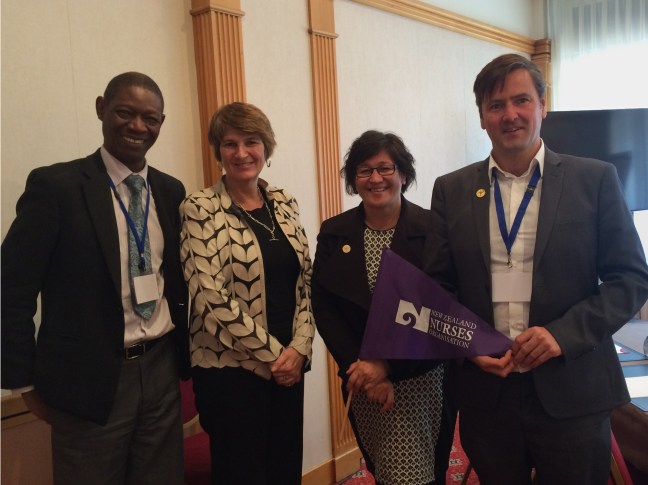
 Notes of my speech to the TPP – Let the People Decide – Binding Referendum Rally, coinciding with the release of the Select Committee report. (Photo: Sandra Grey)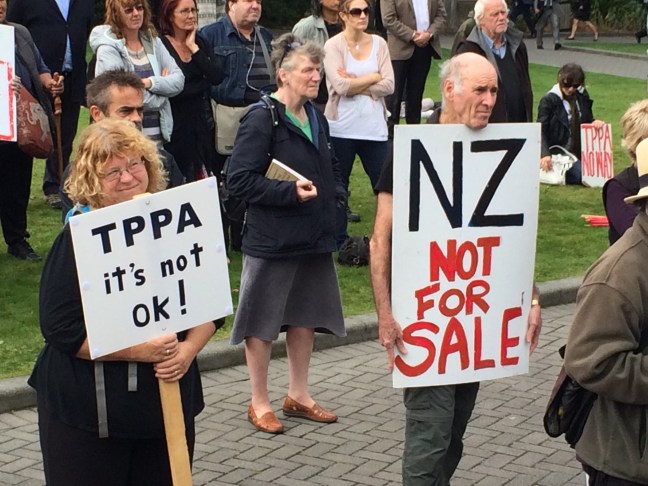
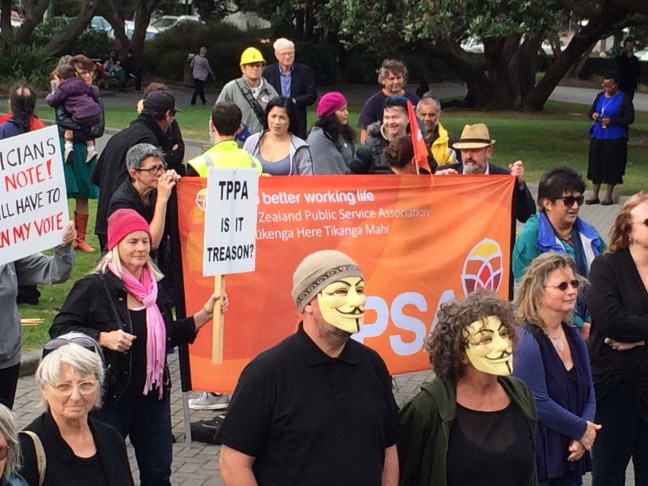


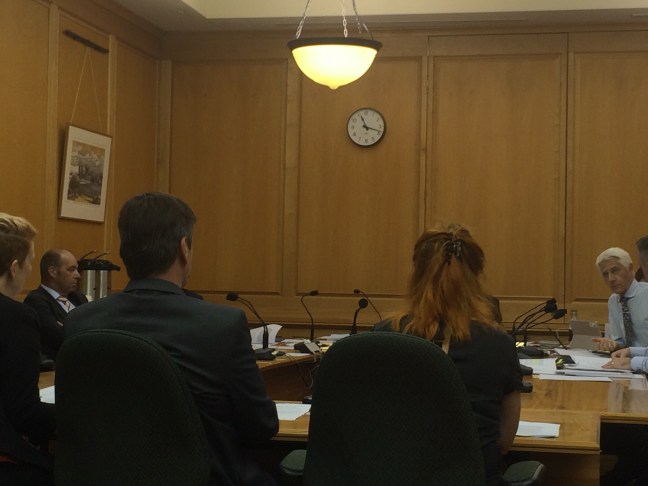
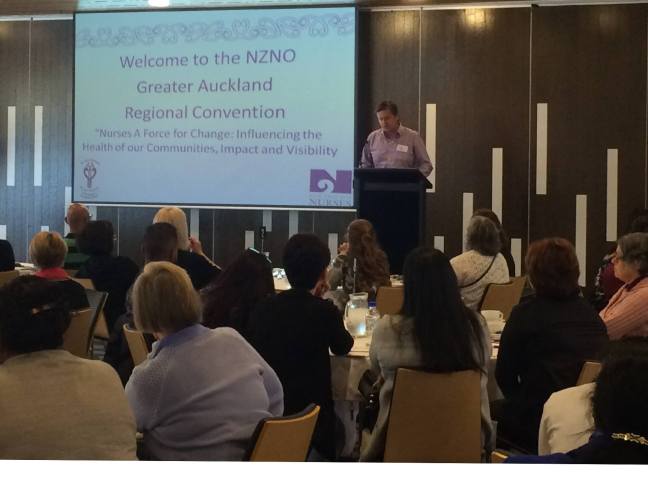 E ngā mana, e ngā reo, e ngā karangarangatanga maha e huihui nei, tēnā koutou.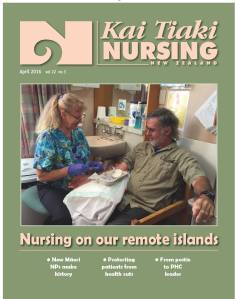
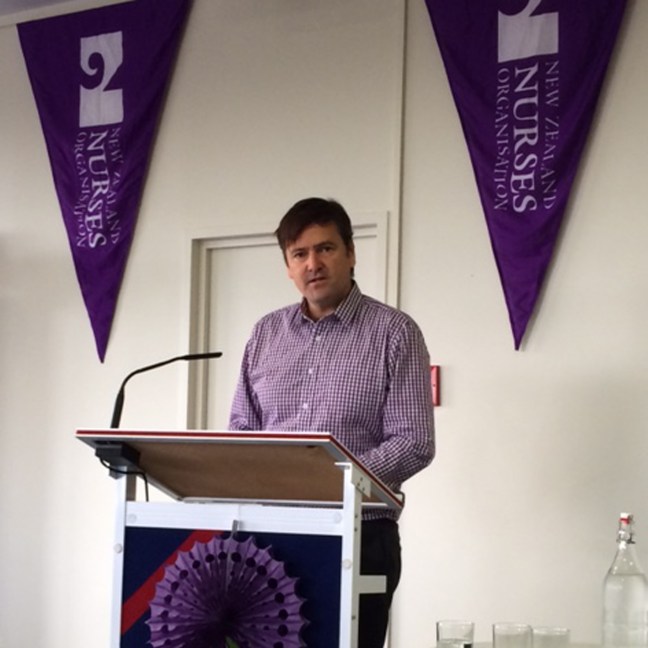

 ASK ANY nurse to name the
 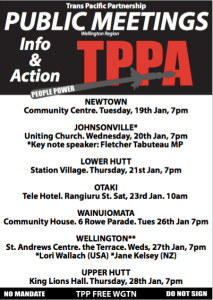 Notes of a talk given at public meetings in Newtown, Lower Hutt, Otaki and Wainuiomata organised by TPP Free Wellington and the Horowhenua TPPA Action Group, January 2016.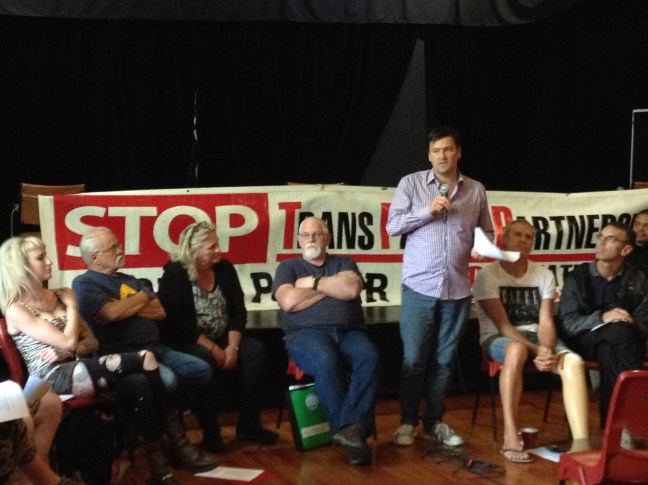

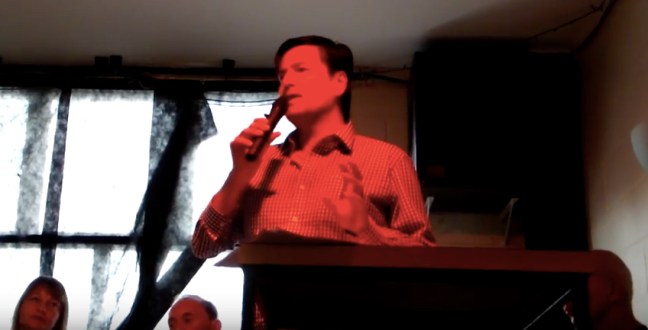
 Your Choice. Your Voice | Grant Brookes for NZNO President